
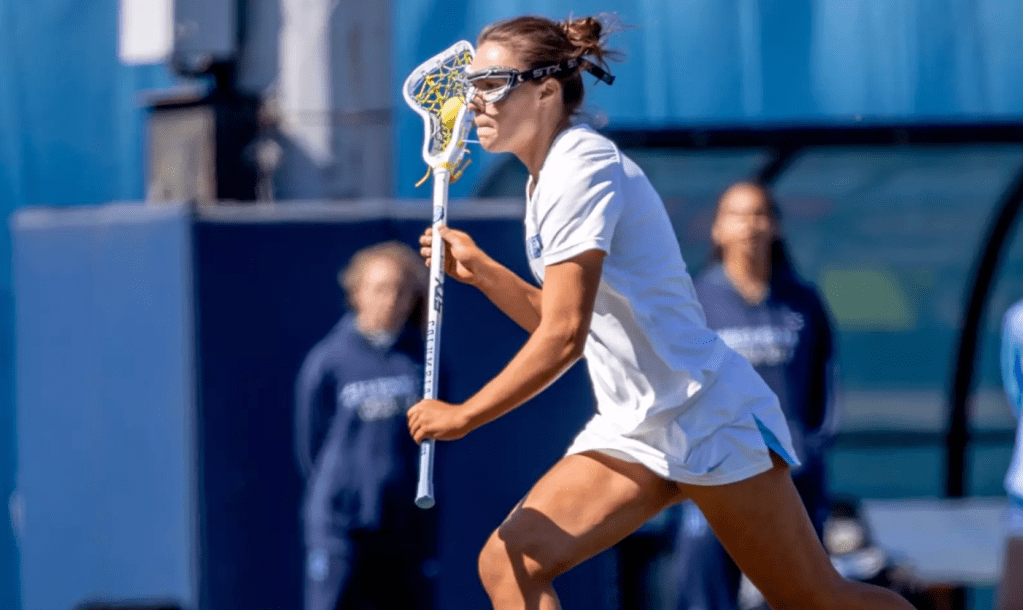
At Rocco B. Commisso Soccer Stadium on Saturday, April 25th, Columbia women’s lacrosse truly saved the best for last.
With the game tied against Harvard at 10–10 in overtime and barely two minutes left, the ball found its way to junior attack Anna Becker, who buried her 43rd goal of the season to give the Lions their first Ivy League win since 2019, 11-10 Columbia.
“The biggest thing I felt was immense pride in our team, because that moment was the culmination of so much hard work from everyone all season,” said Becker. “Our defense got huge stops in overtime to even give us those opportunities, and everyone on the field truly believed we were going to finish it. It was such a special team moment and certainly one I’ll never forget.”
(Link to play: https://www.instagram.com/reels/DXkUuFiD2hS/)
The April afternoon was miserable in every meteorological sense: cold, messy, and overwhelming in heavy rain that turned the turf slick and the air raw.
Despite the conditions, players screamed in excitement while sprinting from every corner of the field, arms wide open, crashing into the stands to find their friends and families.
Rivers of happy tears rapidly streamed down their faces, with no one loosening their grip on their loved ones.
The golden goal carried the weight of seven years of rebuilding, a moment felt deeply by everyone who believed the Lions could find their way back. For fifth-year head coach Anne Murray, the breakthrough felt inevitable.
“We knew we were going to accomplish this win this year,” said Murray. “The team has been so driven and focused on our goal and it means everything that we were able to realize it. This is a huge victory for these players and one that hits the hearts of all our alums, family and friends.”
Columbia regularly battles programs like Yale University and Princeton University for recruits, along with Big Ten and ACC schools, but the Lions are often fighting against decades of established success elsewhere.
Last summer, Murray had hired two assistant coaches who accelerated everything tremendously: Maggie Brown from Princeton, where she helped the Tigers go 16-4 with two NCAA Tournament wins, and Jourdan Roemer from Canisius, the program’s all-time leading scorer, who both rebuilt Columbia’s offensive and draw units from scratch.
“If you want something you’ve never had, you’ve got to do something you’ve never done.” – A quote many attribute to Thomas Jefferson.
Ever since her college playing days at Princeton University, Murray has carried the quote with her, using it to help shape Columbia’s belief and identity.
“Anne has done such a good job,” said Steve Speedling, the Columbia Lacrosse Sports Information Director who’s witnessed the growth in the program, “What I’ve noticed in the four years I’ve been here is you can just see and feel, just by being around the team, just a whole new kind of level to both the competitiveness of the team, but just the culture and the expectations they’ve set.”
Speedling describes the past few years as an “uphill battle” that they’re constantly fighting every day. As an SID, he watched the press box erupt into chaos, experiencing the win from two perspectives at once.
Part of Speedling was emotionally invested after enduring the journey alongside the team, rooting for them to win. The other part immediately shifted into work mode of videos, graphics, reactions: POST!
“Columbia lacrosse is very good,” said Speedling. “If I compare it to football or basketball, we’re a very solid mid-major team, mid-major conference, but we just so happened to be thrown into what feels like the SEC or Big Ten or whatever, because the Ivy League in women’s lacrosse is just a top conference in all the NCAA.”
The Lions went 7-8 this season, only the second time in program history that they have reached that record, finishing with the best record in Murray’s tenure. Going into the 2026 season, Columbia women’s lacrosse, launched in 1997, has compiled a program record of 135-264, including an 11-174 mark in Ivy League play, with one tournament appearance in 2018 resulting in a first-round exit.
For Marisa Marcellino ‘08, JRN’14, a former Columbia lacrosse captain and the program’s leading scorer in 2008, that excitement of program achievement came through a phone screen.
“I was so pumped when they won against Harvard,” said Marcellino. “Seeing the score on my phone… you’ll always feel a part of that, and you know what that means.”
She does know because she was there for the first Ivy League win ever, and it happened to be against Harvard, too.
At 5 feet tall with beaming energy, Marcellino arrived at Columbia in the fall of 2004, a kid from Northwest DC who hadn’t even picked up a lacrosse stick until high school. Her dream was to go to Notre Dame and play lacrosse, but that didn’t go as planned. She was told they went with a taller girl, so she wasn’t recruited, and she came into Columbia thinking she might transfer.
As soon as she got on campus, she stayed, fell in love with the program, and New York City.
She was a freshman on April 23, 2005. It was a date Marcellino still remembers vividly because of her love for Michael Jordan. The number 23, paired with Harvard’s Jordan Field, felt like a sign the day Columbia did something it had never done before.
“I remember scoring a goal late in the game and people going crazy,” said Marcellino. “I think we went up by two, and then we won. And all of a sudden, I look around, and everyone’s crying like, people are sobbing. And I’m like, not fully getting it.”
She scanned the sideline. Her senior teammates, women who had played through years of conference losses, were overwhelmed.
Marcellino didn’t fully grasp the weight of the moment then. For the first 8 years, the Ivy League was simply a wall.
The Lions lost every single conference game with the first head coach, Celine Cunningham (1997–2001): 23-50 overall, 0-28 in Ivy play. She showed the program’s first signs of life with back-to-back 7-8 seasons in 1999 and 2000, but remained winless in conference play.
“I was so pumped. We won, and I was like, great, keep it moving,” said Marcellino. “Then I realized that this was the first Ivy win in the program’s history, and I was just thought wow, we’re going keep this rolling, but there’s obviously like so much more to it than that.”
Stacking Ivy wins didn’t keep rolling during her time at Columbia until after graduation, when head coach Kerri Whitaker (2002–2010) led the program to its first winning season in 2009. Now, Whitaker is the Senior Associate Head Coach for UPenn women’s lacrosse.
“She was very, very intense, driven, wanting to take the program to the next level,” said Marcellino, describing Whitaker’s leadership.
Kerri Whitaker (58-77 overall, 2-61 in Ivy play) made history in 2005, delivering Columbia’s first-ever Ivy League win.
After the game 21 years ago, she said, “It was a huge win for our team and our program. The team is proud of itself and ought to be.”
Whitaker followed it with a second conference win and the program’s only winning season in 2009, and resigned in 2010 for personal reasons, proving Columbia could compete and leaving a foundation for every coach who came after.
In 2026, when Becker’s overtime shot hit the back of the net on Saturday, Marcellino felt the full scope of both moments at once: the freshman who almost missed the magnitude of history, and the alum who understood exactly what it cost to get back there.
“I think losing is really difficult,” said Murray. “When you have that collective experience, and you don’t have the culture to counteract it, it becomes really toxic.”
After losing 34 consecutive Ivy League games since April 2019, the program’s astronomical cultural growth became the payoff from years spent changing that losing mindset from within.
Murray said that when her staff arrived, “With all due respect for the alums before, the people on this team didn’t love lacrosse,” and players were often unwilling to sacrifice comfort in order to win.
Players to this day have said they wanted games to be over when they were losing rather than being proactive in making adjustments.
“Players didn’t have the ability to fail forward,” said Murray.
The focus became about changing daily habits and raising physical standards. Murray said the previous culture “did not take the weight room seriously,” forcing the program to rebuild its strength and conditioning mindset alongside its confidence.
“When I came here, there was not a lot of extra work that was going on,” said Becker to USA Lacrosse Magazine. “I didn’t know going early was an option, which kind of sounds crazy. Everyone always worked hard in the weight room, but it’s nothing like what it is today. It’s a good indicator of how far we’ve come as a program.”
Murray emphasized putting in extra work, staying accountable, working on strength development, and actually loving the sport of lacrosse. The new identity became about resetting the standard and building confidence.
In the 2026 season against Brown, the Lions battled down to the wire, falling by a point with under 10 seconds left, while against UPenn, they trailed just 5-4 at halftime before the Quakers pulled away late. Columbia also led Dartmouth College 3-2 after the first quarter before Dartmouth responded.
“I think there’s a mental thing. Knowing you deserve to win. Knowing you deserve to be here. Because clearly it’s not a talent thing if you can keep it that close [in game],” said Marcellino.
Even though those were nail-biting close losses, those games proved the Lions were no longer viewing Ivy League opponents as untouchable powers.
“We don’t necessarily have to look at it as David versus Goliath,” said Speedling. “We could look at it as more of: We’re on the level with all these teams.”
To understand what an Ivy League win means to the program, it’s important to understand the big picture of where the program came from.
Columbia women’s lacrosse didn’t exist until 1997, arriving over two decades after Cornell (1972), Princeton (1973), and Harvard (1976) had already built programs, pipelines, and winning traditions. Also, Columbia doesn’t even have a men’s lacrosse team, but that’s another story.
The structural disadvantage shaped everything, and the program has spent 29 years trying to close a gap that was built into its foundation before it ever played a game.
“Harvard, Princeton… those schools have had women’s lacrosse teams for like a hundred years,” said Marcellino. “And we hit 25 years as a program, and that was a huge deal. But when you’re going up against these institutions, it’s so hard to build.”
While the gap is closer to 20-25 years, it carries the weight of a century, propped up by generations of men’s Ivy League lacrosse tradition that gave those programs a cultural and institutional foundation. Columbia is still working to build from scratch.
Marcellino also understood what the program offered that the powerhouses didn’t: playing time, immediacy, and impact.
“I played every minute of every game for four years,” said Marcellino. “That is just not something that could have happened anywhere else, probably.”
After Whitaker’s departure, the program felt stuck in a cycle alumni witnessed: a coach arrives with energy and vision, spends years rebuilding, shows flashes of progress, and then, just as momentum builds, the clock runs out.
“Any alumni that you talk to would be like… it hurts [to lose],” said Marcellino. “And I feel such pride when they do well. I just want them to be at the top, like where they deserve to be. We would all chip in to help get them where they need to be.”
Liz Kittleman Jackson (2011–2015: 18-56 overall, 2-33 in Ivy play) added conference wins in 2011 and 2015.
Andrea Cofrin (2016-2020: 23-45 overall, 7-24 in Ivy play) built the program’s best-ever Ivy record in 2018 and earned its first Ivy Tournament berth, before the pandemic cut momentum at a critical moment.
Murray arrived in 2022 and has gone 2-13, 3-12, 4-11, 4-11, and now, 7-8.
For years, Columbia cycled through head coaches roughly every five seasons while piling up losing records, forcing staff to get creative on the recruiting trail. Recruitment for Columbia lacrosse is tough, with the process being less about volume and more about patience, timing, and fit.
Summers from June through July are the heaviest recruiting months, with the staff constantly traveling to club tournaments, camps, and clinics before another major push arrives in September, targeting sophomores and juniors.
“Every coach needs at least a full recruiting cycle, and then the ability for those students to play and come through,” said Marcellino. “But I just don’t know what you do when you’re so many years behind other programs in institutional learning, in learning how to win.”
Recently, Columbia coaches have leaned into authenticity during the recruiting process, selling recruits on the reality of choosing one of the most demanding academic and athletic environments in the country.
“There are times when we come up against these other Ivy League opponents who have a winning tradition,” said Murray. “People want to pick [any Ivy League program], and when you go in that head-to-head battle, we’re not necessarily winning those recruits over, but I think we’ve had to get creative with who we’ve had to pick.”
The challenge extends beyond recruiting pitches. Columbia carried just 28 players on the roster this season despite the Ivy League travel limit allowing 32, and admissions standards create another hurdle in finding what the staff calls the “difficult athlete,” someone elite enough as a lacrosse player while also capable of thriving academically at Columbia.
That patience paid off with Anna Becker. From 2019-2023, Becker attended Bronxville High School in Bronxville, New York, which is about a 30-minute drive from Columbia’s campus. She was a tri-sport varsity athlete playing lacrosse, basketball, and tennis.
“We waited a long time for Anna to make the decision about Columbia, and it was worth every minute of it,” said Murray.
From practice to game time, the passion in every single person on the team and the program will carry into next year. Some of the most historic milestones are beyond the Harvard win, including roughly about 10-15 major program achievements in the 2026 season.
“When I first started, there really wasn’t checking the record books,” said Speedling. “There was no keeping up to date with who’s on what list, because unfortunately, there was just nothing to keep track of.”
This season’s Columbia women’s lacrosse milestones included their first Ivy League win since 2019, the largest scoring game in program history (against Howard), the biggest margin of victory in program history, and the program’s highest win total in years.
Individual offensive milestones triumphed like senior attack Cece Messner, who climbed into the top 10 in program history for goals, assists, and points in a season, while the team finished top 10 nationally in assists per game.
What’s next for Columbia lacrosse is a goal that hasn’t changed from the beginning of the 2026 season: to make the Ivy League Tournament and NCAA tournament berth.
The overtime win over Harvard did more than end a drought. It proved the Lions could compete in one of the toughest conferences in the country, while exposing how close they already were.
“Our goal was to make the Ivy League Tournament,” said Murray. “I wanted us to be better.”
For Columbia, this means investing more into consistency, becoming, as Murray calls it, “gym rats,” by building a tougher identity physically and mentally. The growth showed up all season, from close battles to little wins in practice, translating right to big game victories.
“That one is very important,” said Murray about the Harvard win. “But this program is about sustained growth and moving forward.”


Leave a Reply