
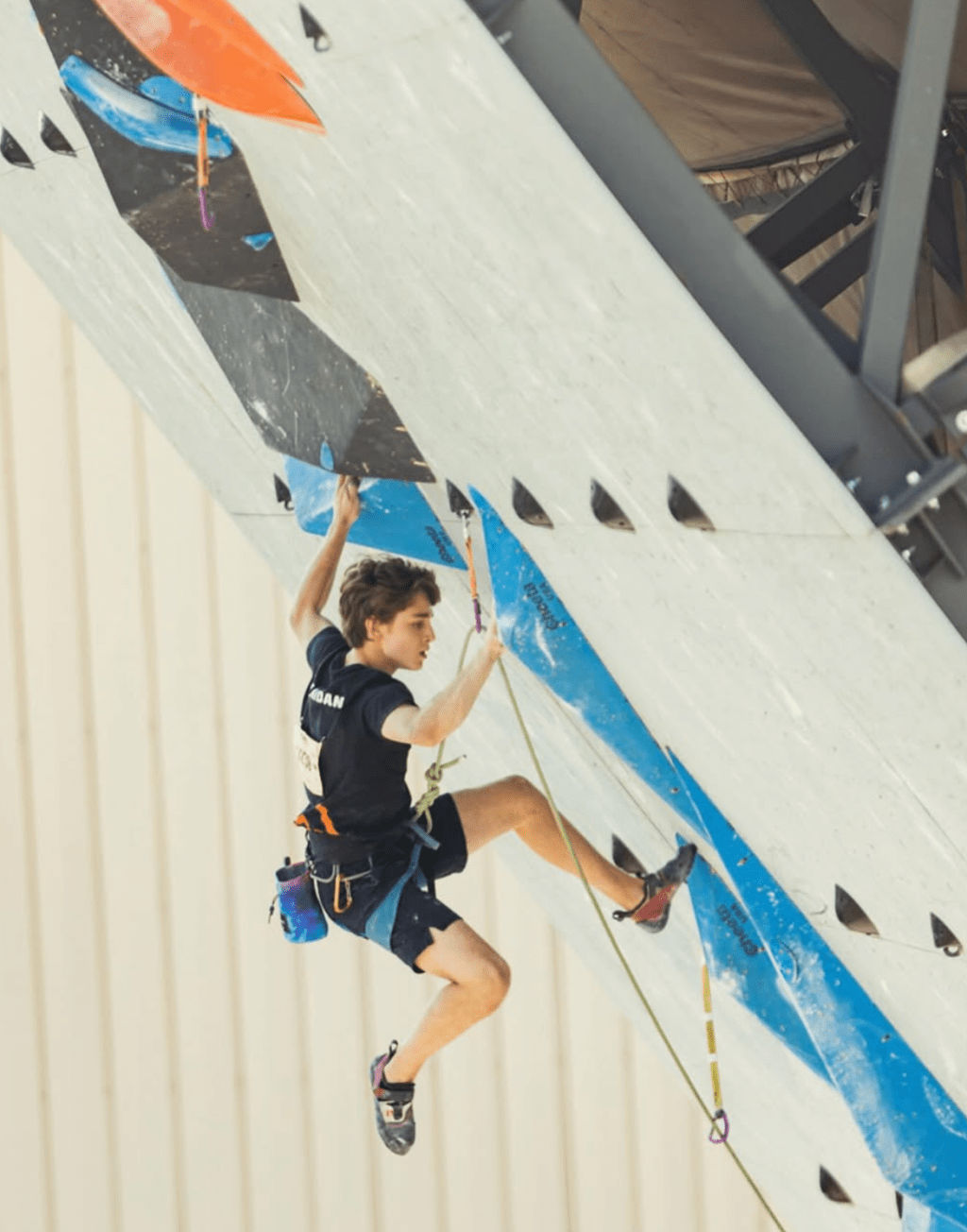
To be a youth competitive rock climber in New York City means spending almost every night in crowded industrial-style gyms with cold concrete floors. You arrive in the clothes you wore to school and leave covered in chalk, mysterious dirt marks and sometimes blood. You socialize and train with fellow climbers twice your age, and compete with yourself on a daily basis. The competitive side of the sport is so consuming that many forget its origins while scraping across colorful, plastic holds.
At its roots, indoor climbing was once just a means of training for the outdoors. Beckett “Bex” Ballow, a 16-year-old climber from Brooklyn, hasn’t forgotten. If anything, he’s brought a fresh perspective to rock that is millions of years old.
“Some people talk about when they were a little kid—the second they touched the wall they knew they were gonna be amazing at this…I definitely wasn’t like that,” Ballow said.
Like many New Yorkers, Ballow doesn’t own a car, turning a trip to The Gunks, a world-famous climbing destination in New Paltz, from only two hours by car into nearly six by public transit. Luckily, the Hudson Line covers about two-thirds of the way there, but after that, Ballow has to rely on his friends—or whoever he can convince to drive. Not to mention he has to carry a crash pad, which usually averages 4 feet in length, on top of any other equipment he needs for the day.
“To project climbs at The Gunks, or just to get outdoors on a typical day is kind of difficult,” Ballow said.
Sometimes, Ballow and his dad ride up together in a rented car, but other times, he prefers the adventure. He noted that an ideal day out climbing would be in chilly temperatures with good friends—and maybe a story or two of getting lost along the way. In outdoor bouldering, V0 is the easiest grade, with V18 being the hardest—which only one climber has ever achieved. For reference, someone who trains five to six times per week indoors may only ever reach climbing a V7 outdoors in their lifetime. In the summer of 2024, Ballow sent his first outdoor V10 at 14 years old. Only a few months later, he got his first V11 called “Collateral Impact” at The Gunks.
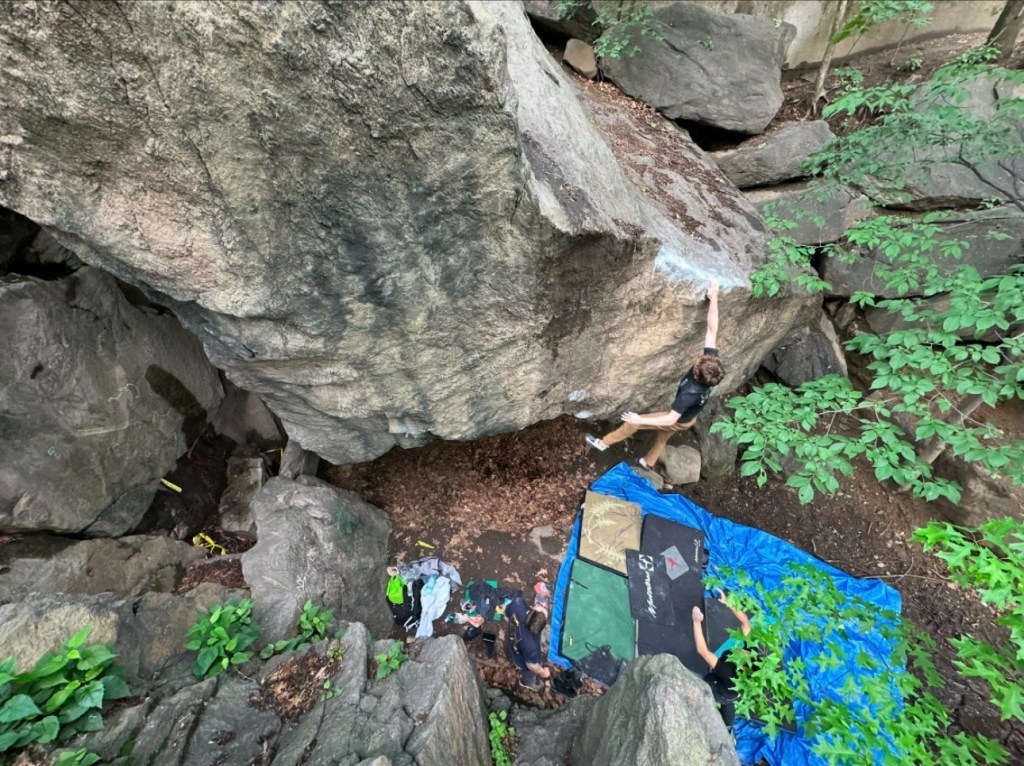
Bex Ballow climbing “Yo-yo Jiminy”, Central Park, May 2025, credit: Chantel Erin
“Throughout 2024, I kind of took outdoors casually. I saw myself more as a competitor. I didn’t quite see myself as an outdoor climber,” said Ballow even as he continued to tick climbs that surprised everyone around him.
The year that Ballow really embraced the outdoors was in 2020, when it seemed like everybody else in the world was doing the same thing. The pandemic disrupted everything about indoor climbing. It was a difficult case for climbing gyms to pitch that their hot, poorly ventilated facilities where thousands of people touched the same surfaces every day should remain open.
But, there are no doors to be locked in the woods of Ice Pond in Brewster, or the endless expanses of rock along the Shawnagunk Mountains.
Like many New York City families, the Ballows escaped the choking concrete of the city, favoring weeks away in rural areas like New Paltz and visiting relatives in Western Massachusetts. It was inevitable that Ballow got a jump-start in outdoor bouldering.
As his outdoor milestones continued, so did his results at indoor climbing competitions; however, his mindset was starting to change.
Ballow competed in his first competition when he was 9 years old while on a youth climbing team in Queens. His parents were at a standstill of where to put a kid that had so much energy, who wasn’t catching onto any traditional sports. It wasn’t until he was recruited by a coach, Emily Varisco, that something clicked.
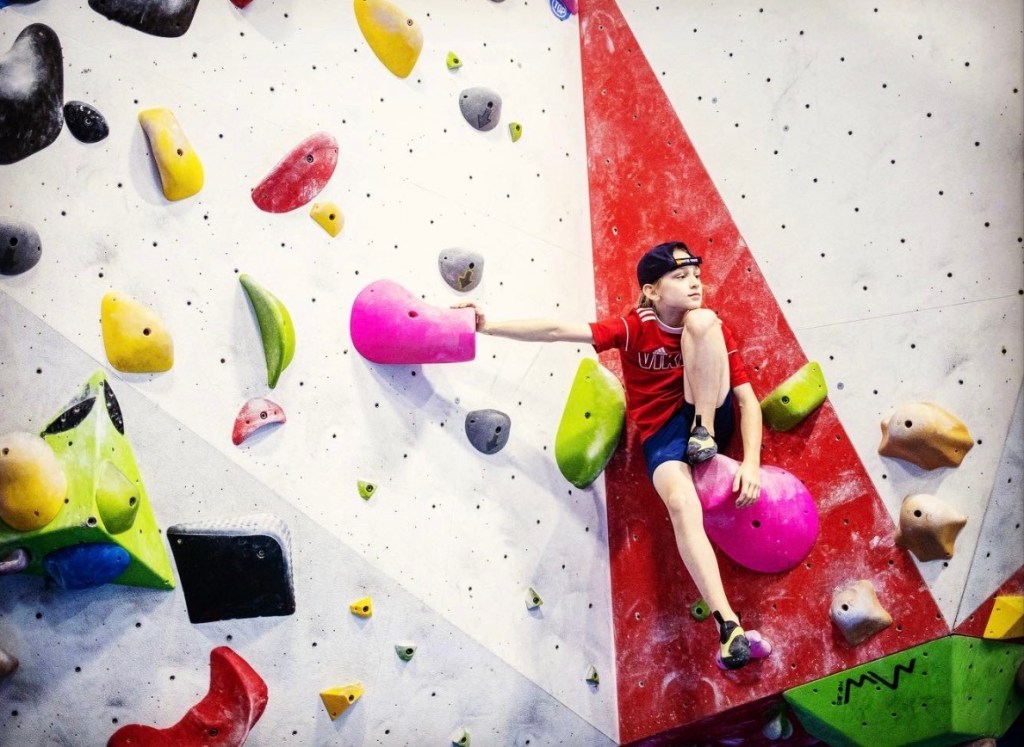
Bex Ballow sitting on a climbing hold at The Cliffs in Long Island City, Queens, 2019, credit: Emily Varisco
Varisco was coaching a youth summer camp at The Cliffs in Long Island City, when Ballow’s personality and attention to detail stood out from the other kids.
“Whenever I talked to him about his climbing specifically, he stopped immediately and had a conversation about it,” Varisco said. “He just seemed to care a lot about what he was doing and what he was learning—even though it was just summer camp.”
Early in his career, Ballow trained alongside teammates who were often several years older. Varisco recalled how those climbers treated him less like a kid and more like a peer, recognizing his ability.
Katie Leton, one of those older teammates, was 17 when he was 12. At The Cliffs, climbers of all ages and experience levels were usually mixed together at the beginning and end of practice. Leton, who was weighing college options, would warm up alongside Ballow who was dealing with the challenges of middle school.
“He was always trying to push himself and put in the work outside of practice doing private lessons,” Leton said. “I feel like he was one of the kids on the team who handled the pressure of competition well, whereas I feel like I was always super stressed and nervous going into comps.”
Another former teammate, Sydney Chong, agreed with this sentiment, remembering how she witnessed Ballow compete with composure.
“He wasn’t the type of kid to cry at a competition, and plenty of us did cry,” Chong said. “He was just one of those kids that if you saw him when he was really little you would be like ‘oh he’s gonna be one of the top youth climbers.’”
As his older teammates started to graduate, Ballow was attending his first national competition wearing his then usual attire of a backwards cap over a scraggly dirty blonde ponytail. All in all, Ballow has competed in multiple national indoor competitions in every discipline, with an average of about 15 local, regional, and divisional competitions in between every season.
But this year, Ballow hasn’t competed at all.
“I really loved competition for a long time. I still love it, I just need a break from it right now,” he said, “The better I got at competition and the more I climbed outdoors, I just enjoyed the process of being outdoors so much more.”
Climbing competitions are intense, specifically on the youth level, where your entire season can come down to one attempt—on one day. For bouldering at a regional, divisional and national level, climbers spend what can sometimes be hours in “isolation” where they warm up in a room with all of their peers and coaches out of view of their climbs. The point of this is so that nobody gains the advantage of watching anybody else’s attempts. When your time is called, you’re on your own.
Before climbing was added to the Olympics in 2020, standard competition problems were more technical, condensed and mental. Once organizers realized they had to appease an audience that wasn’t there before, moves on climbs became more similar to parkour, a sport where you often leap between and over objects using just your body. Athletes who are best at slow, static movement were now getting slowly replaced by those that can leap and land on ever-more colorful plastic that strayed even further from the granite they once tried to replicate.
For athletes like Ballow who developed their climbing style before this change, competitions became harder to adapt to, as well as the mindset needed to enjoy it.
“I got in my head about my style and what I was good at,” he said. “People won’t see how good I really am because what I’m good at isn’t what they’re putting up.”
Still, Ballow boasted incredible results, almost always securing a ticket to nationals just by showing up. But, the impending burnout of constantly stressing to stay at that elite level motivated his escape into the wilderness, where there were no judges, scorecards or ticking clocks to be seen. Although it was a difficult decision for him emotionally, he stepped away from youth competitions in December, opting to climb outdoors instead.
“Divisionals was this weekend (April 11-12), and I went outdoor climbing instead—and it was such a good day. I got to hang out in a forest with a great crew and great weather, while all my other friends are stressing out about climbs they might not even like—and results. I just got to hang out in the forest and work on a really fun boulder,” Ballow said.
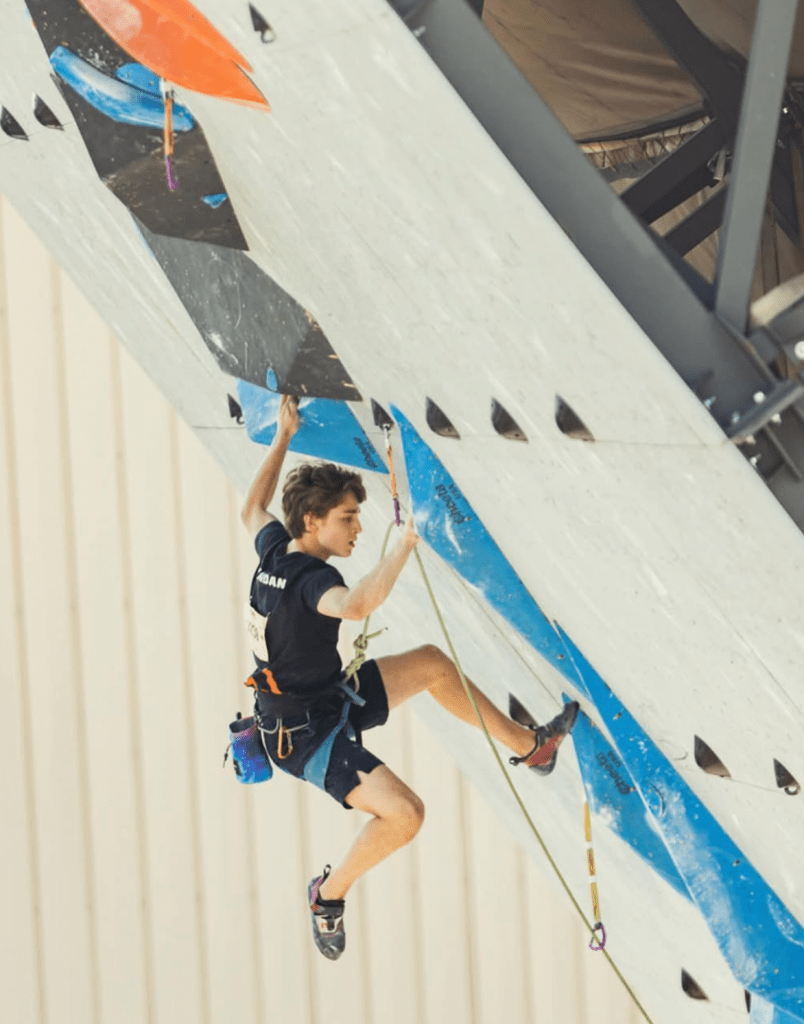
Bex Ballow competing at USA Climbing youth lead nationals, July 2024, credit: Caleb Timmerman
Ballow holds close his memories of pride and comradery at nationals, but that one celebratory weekend each year wasn’t enough to outweigh the negativity he felt at regionals and divisionals. Stepping away from traditional competition doesn’t mean the pressure simply disappears from your performance. The culture of outdoor climbing is competitive in its own way, with up-and-coming sponsored athletes spending days, months—sometimes even years of sporadic days outside just to break into a new grade. In moments where Ballow experiences this often self-inflicted pressure, he reminds himself to enjoy the process wherever he may be.
When he feels too consumed by a climb, he steps away and works on something easier, with no plan other than experiencing climbing at its core—no phones, no scorecards and zero judgement.
“I just get out. No beta—no idea other than where the start hold is and where it goes,” Ballow said.
The question of where he’ll be next is still in the air as he enters his senior year of high school in the fall. Salt Lake City or Boulder are two of his top choices, as they possess some of the largest hot-spots for youth climbers looking to extend their competition careers. However, Ballow is more drawn to how close the two cities are to supreme climbing locations like Moab and the Rocky Mountains. For now, it’s unclear if Ballow will go back to competing in the youth or open circuit, as he can’t relate to the enjoyment as much as he used to.
“I do think the attitude towards youth climbing has gotten more like baseball and soccer where people see each other as competitors, and it’s not like… us against the wall.” said Ballow.
Ballow’s outdoor journey is nowhere near over, especially if he attends a school out West. He has even partnered with a climbing clothing company called Sendology. But, no matter where he chooses to continue training, he’ll be one of the few accomplished climbers who got their start in the heart of New York City.


Leave a Reply