
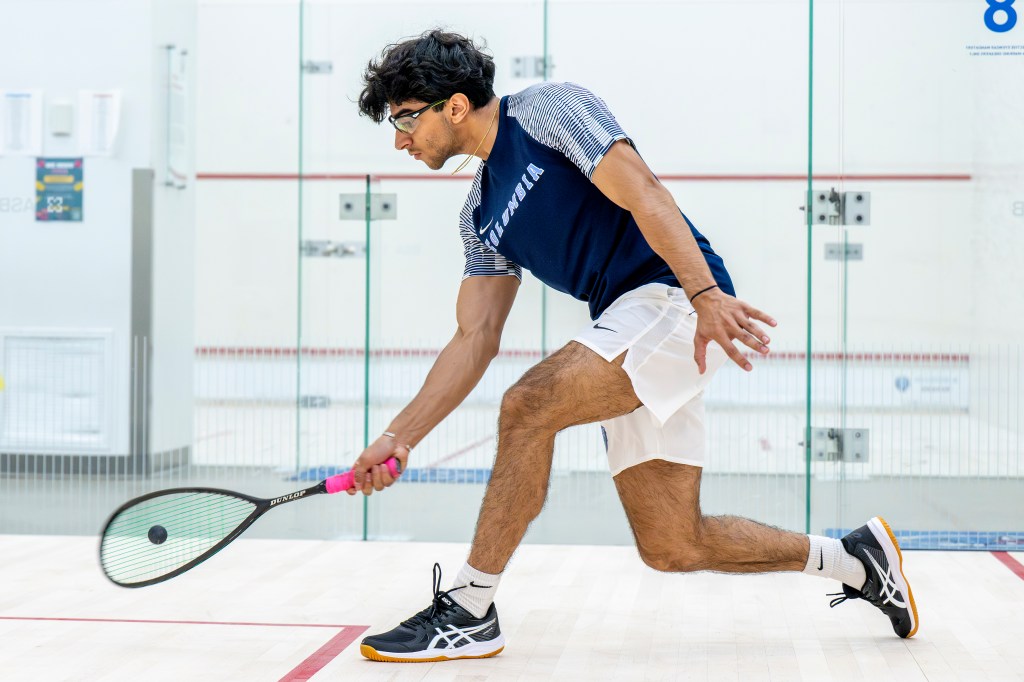
It’s just a typical day for the eight million people in New York City, but for one college squash player at Columbia University, it’s game day. Whether it’s mental preparation or superstition, Arhan Chandra has to do everything three to five times. From flipping the light switch on and off to walking in a certain direction to turning his phone on and off, it’s something Chandra has been doing for years before he competes.
Squash players must win three out of five games to beat their opponent in the match.
Some might call it correlation—or even craziness—but it’s all about believing in the process for Chandra.
Chandra’s story represents more than a quest to get the number one spot on Columbia’s squash team. It’s about everything it takes to get there, from having the competitive mental fortitude to train for hours to having the hunger to bounce back from his injuries. Squash has given him a sense of community, purpose, and the drive to unlock his full potential.
Standing at 5’9″ and weighing 158 pounds, Chandra looks like a typical college junior on the outside. But deep inside, there is a hardworking, competitive athlete who is willing to do whatever it takes to bring his A game.
As with any athlete, the losses hurt more than the wins, but Chandra sees both as learning experiences. He believes that failure is an important part of his process. It taught him to rewatch where he made a mistake and adapt.
“The matches I lose [that are] very close, [I] can take away [from] that [to] use as motivation to train harder and fight back stronger,” Chandra says.
His story started in the outskirts of London, England, where squash is popular.
Arhan’s father, Rishi, played squash and took Arhan with him to the Gerrards Cross Squash Club, located in Gerrards Cross, England.
“I first started playing when I was six and then ended up quitting because I wasn’t having fun,” said Chandra.
Three years later, his attitude towards squash changed.
“But then I moved to [Chesham Bois Tennis & Squash Club in Amersham, England] and at nine years old, I started playing again,” he stated. “I fell in love with the sport because a lot of my friends were playing. My dad was playing and from there on, I always loved it.”

As a child, Chandra participated in various sports. He played tennis, cricket, was on the track and field team, and swam. He could have been a multi-talented athlete, but he took squash more seriously. His love for squash dominated, and nothing could break it.
Squash helped him grow as a person. Chandra competed in Europe, Australia, North America, and South America at a young age. Unfamiliar territory brought him new experiences, cultures, and opponents.
“It’s made me more open to meeting different people,” says Chandra. “I’ve just met so many and interacted with so many people.”
He wanted to thrive on the world stage.
“It’s turned me into a goal-oriented person,” Chandra states. “I always want to achieve the best.”
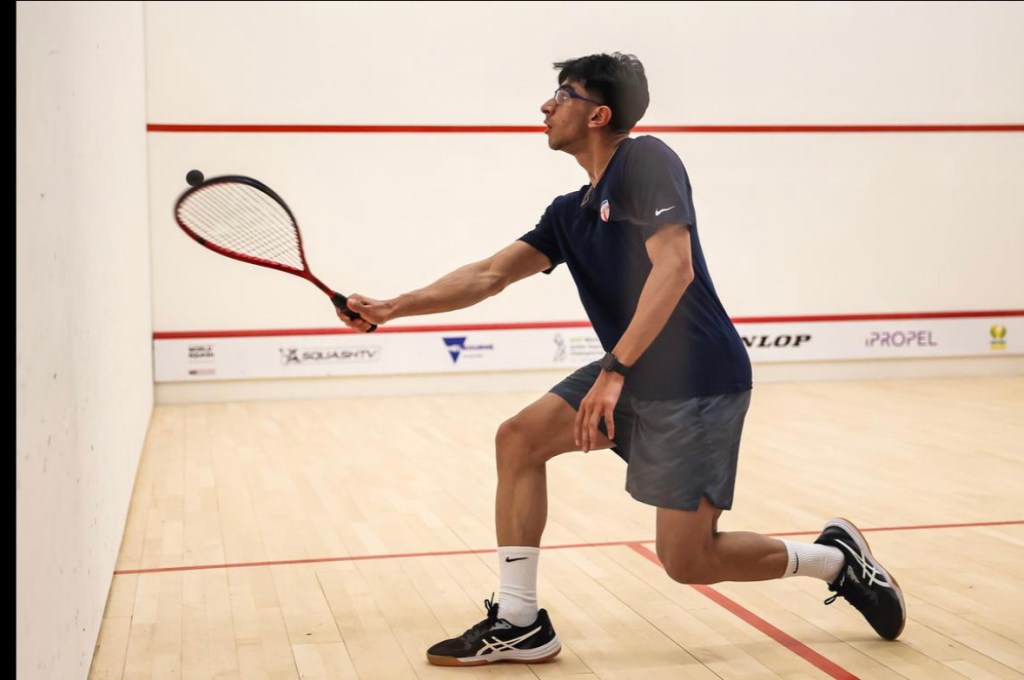
“It is rare to find someone as talented as Arhan with a serious drive to be the best, he is an exceptional worker with a deep mind and an extremely high ceiling in life,” said fellow Columbia teammate and friend Yusuf Sheikh.
Rishi’s career took the Chandras from Chicago to Buckinghamshire, England, and back to Chicago when Arhan was 12. His family moved to Minneapolis a year later. He didn’t find much of a squash community, so he struggled to improve his game and found the transition mentally difficult. Other children around his age trained with other players and coaches, but Chandra had limited resources. “Both [of] those places [were] like a squash desert,” said Chandra.
The Chandras settled in Houston when Arhan was 17. Rishi wanted his sons to be closer to their extended family and to be part of a larger squash community. Chandra’s high school didn’t have a squash team, so he trained at the Houston Squash Club.
Training in Houston helped fill the void he had in Chicago and Minneapolis. “I was able to climb back to the top of the country and play at the top international level again,” said Chandra.
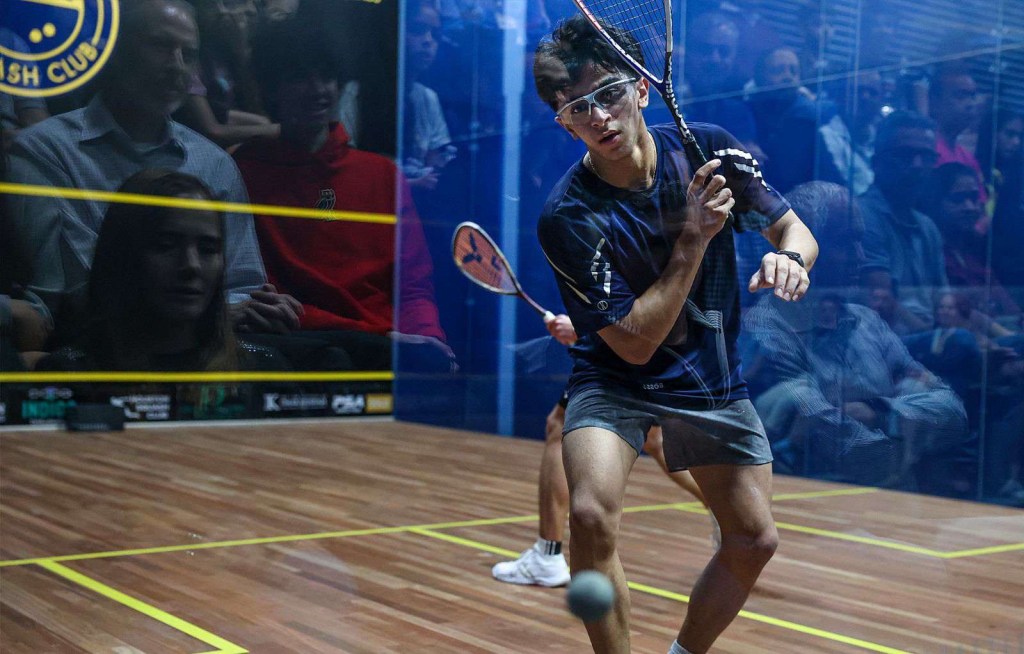
The University of Virginia recruited Chandra to play for them. After graduating from high school, he moved to Charlottesville, Virginia.
At the University of Virginia, Arhan’s toughest opponent was his injuries. After he won his first match, he broke his wrist at practice and could not compete for the next three months. But he used his time away from the squash court wisely. Since he couldn’t hit the ball, he worked on his footwork and movement patterns. His hunger to improve his game didn’t keep him off the court.
“It [was] better when I came back,” Chandra states. “I was being forced to work on it, so you can use it towards good.”
He took advantage of every opportunity and competed for the remaining two months of the season. The suburban isolated environment wasn’t a great fit for Chandra, so he entered the transfer portal and made his way to the city.
“I decided to come to Columbia as I felt like I wanted to be in a bigger city, as I always grew up close to one [and] I have family who live in New York,” said Chandra.
“Arhan has been an amazing addition to our team in so many ways,” said Columbia squash coach, Chris Sachvie. “He has played in the top 1/2 of our lineup both years, been a terrific athlete, squash player, teammate, [and] gained valuable experience competing.”
He’s found a home in New York City. On a typical day, practice lasts two hours, from noon to two in the afternoon, Monday through Friday. Chandra must finish his pre-workout meal by 10:30 AM. Then there’s the practice warm-ups, post-training recovery, and then back to classes.
There is strength and conditioning training two times a week.
But that’s not enough for Chandra; he will put in two additional days of strength and conditioning training, along with an additional squash practice. On average, Chandra dedicates three hours a day to his sport.
Chandra balances this athletic workload with his academics–he’s a financial economics and statistics major and always been on the dean’s list–an internship at Takion Technologies, a quantitative trading firm, and a social life with his friends.
“Squash taught me how to manage a busy schedule,” states Chandra. “I’ve had to miss weekends and classes growing up, so I learned how to manage my schedule accordingly.”
There’s a misconception that all student athletes do is eat, sleep, train, and flake on half their classes. Chandra, and his teammates, take pride in breaking that stereotype.
“Within my squash [team and] me, all of us are very driven, and we perform well [in academics], says Chandra. “We have a lot of hobbies outside of the classroom and squash.”
Chandra’s interests include jiu-jitsu, chess, and poker. He enjoys a variety of friendly competitions. He doesn’t consider himself only an athlete, but a well-rounded college student.
“Arhan has displayed an impressive amount of maturity on and off the court,” said Columbia teammate Imad Athar. “In the heat of a match, he has a balance of persistence without losing his cool, [which] is what makes him such a resilient player.”
Chandra has unfinished business. As he prepares to enter his senior year, he wants more than his current accolades, such as achieving a world ranking of 172.
He wants the Ivy League championship. “I started to see him really unlock a new level of squash,’ said Sachvie. “So with one more year as a Columbia Lion, I am confident he is going to have his best one yet.”
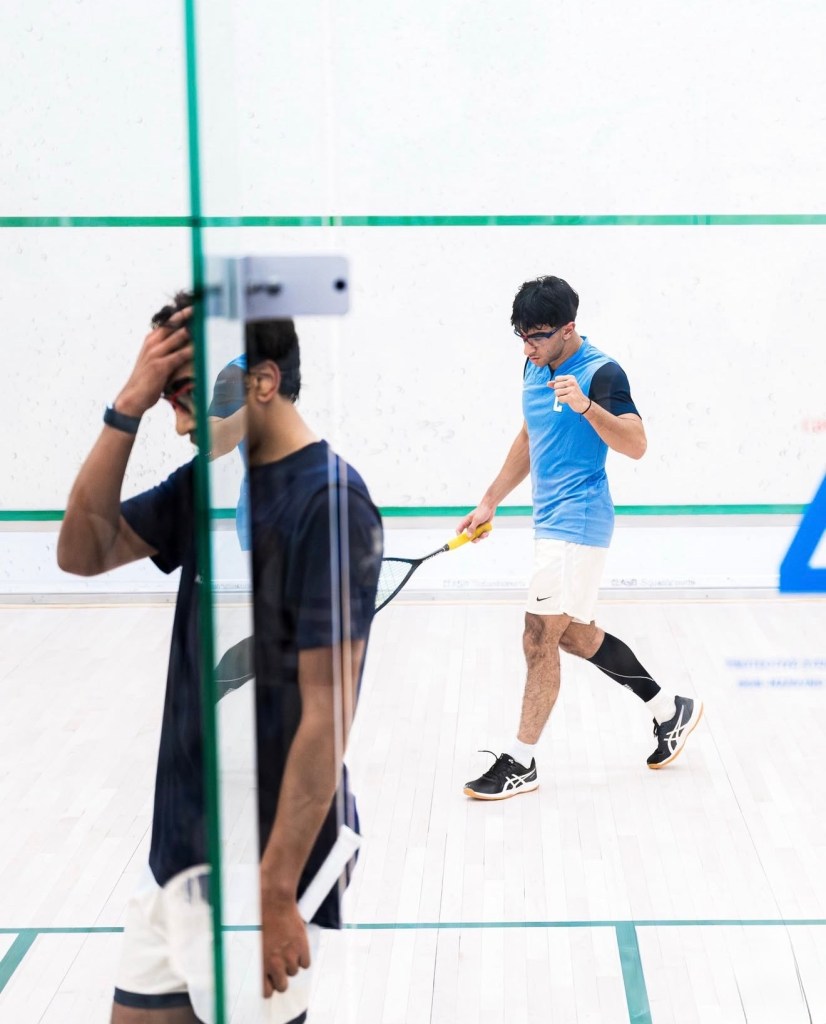
He wants the number one spot on the team.
“I played number one my sophomore year,” Chandra says. “The training that I’m dedicating to playing, I think I have a good chance to be number one again.”
A sure thing: Chandra will be flipping the switch. On and off, on and off. Three to five times.


Leave a Reply