
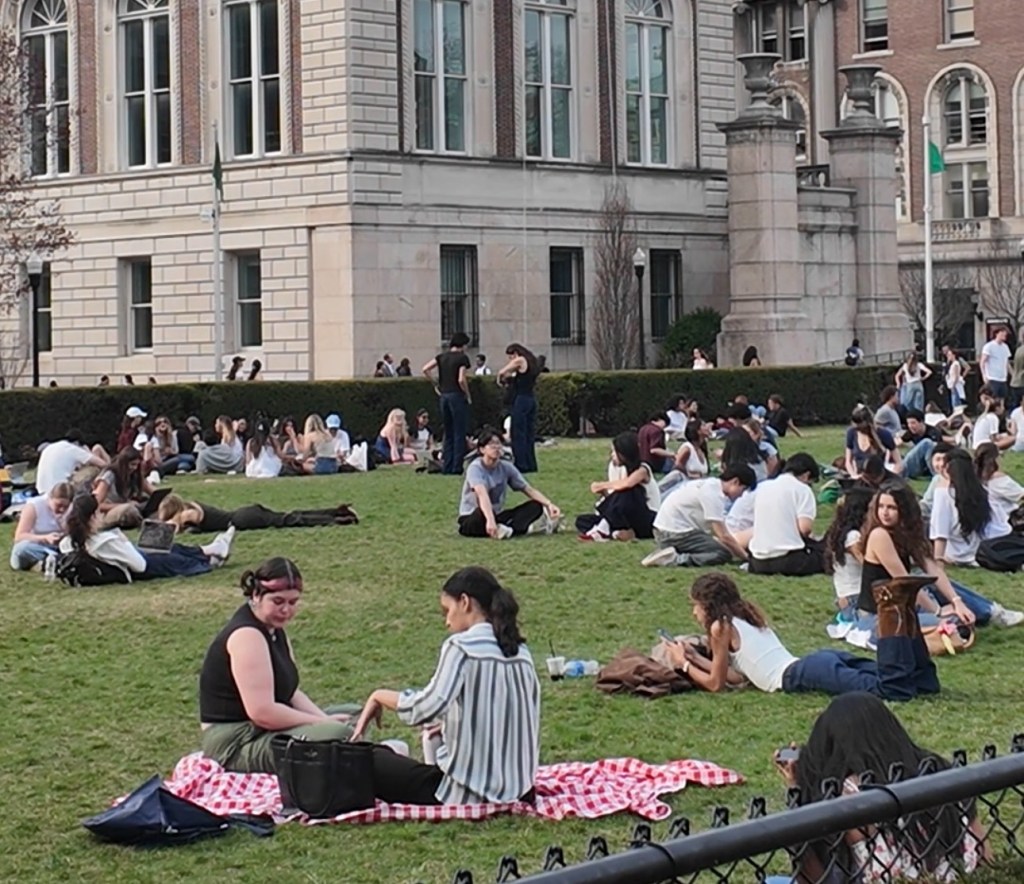
There’s something so freeing about a warm spring day on Columbia’s South Lawn.
Students peel out of Butler library like they’ve been holding their breath all winter, sprawling across the grass in t-shirts and shorts, laughing a little too loud, casually tossing balls back and forth, eating on picnic blankets with friends, and letting the sun do what New York City winters never quite allow.
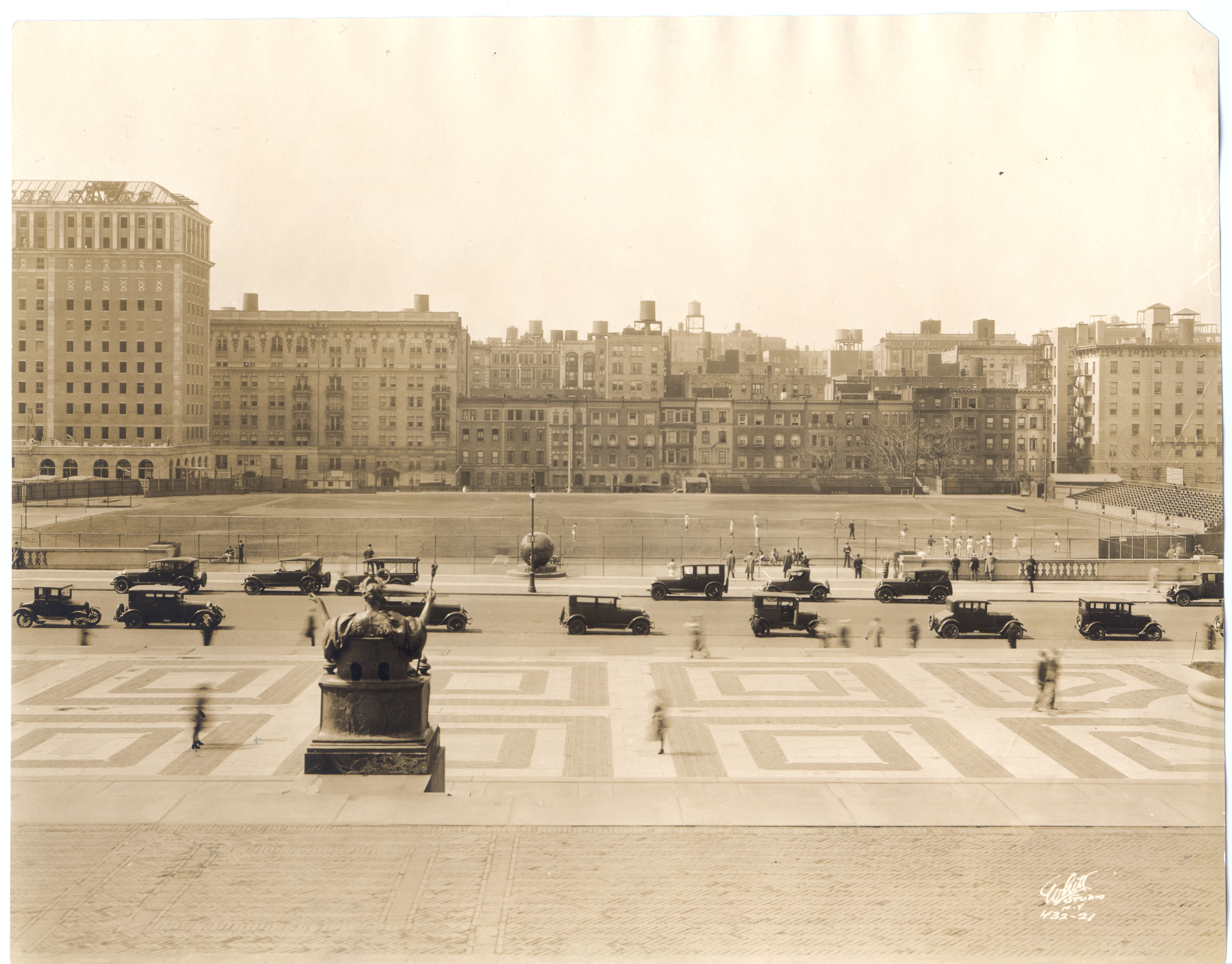
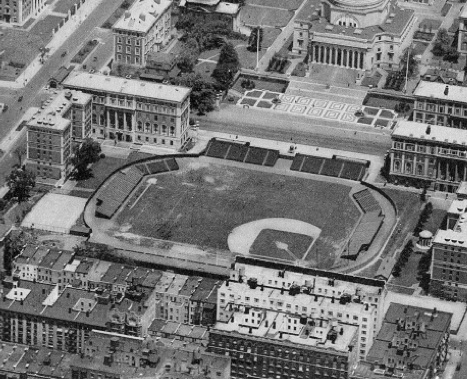
What most, if not all, of these blissful souls don’t know: the very ground beneath their picnic blankets and bare feet was once a baseball diamond, alive with the crack of a bat and the roar of a crowd.
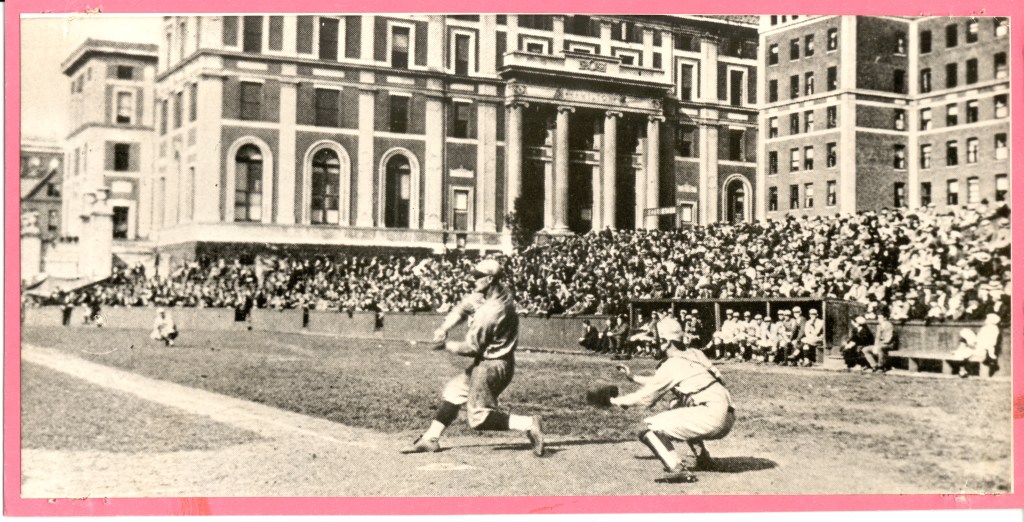
Over a century ago, on that same patch of earth, a broad-shouldered Columbia sophomore named Lou Gehrig dug his cleats into the left-handed batter’s box, locked eyes with a pitcher, and swung so hard that his home runs soared past expectations.
Before he ever wore pinstripes, Gehrig was simply “Columbia Lou,” a kid from Manhattan’s Yorkville neighborhood who arrived at Columbia College in 1921 with a ferocious bat and an equally devastating left arm.
The son of German immigrants, Gehrig had grown up in poverty, shaped by a hardworking mother who pushed him toward education and athletics alike. At Columbia, he played both football and baseball, and it didn’t take long for the Morningside Heights campus to take notice.
In the spring of 1923, pitching for the Lions, he struck out a team-record 17 batters in a single game. At the plate, Gehrig was even more terrifying, launching home runs that traveled over 400 feet. After his sophomore year, the New York Yankees came calling, signing him for a $1,500 bonus. (After 1923, varsity baseball shifted to Baker Field, which Columbia had purchased in 1921. The old South Field eventually gave way to the campus expansion known today.)
Gehrig anchored the Yankees lineup alongside Babe Ruth for over a decade, driving in 100 or more runs in 13 consecutive seasons and leading the team to six World Series titles. Before the records, the Hall of Fame career, the farewell speech at Yankee Stadium, there was South Field, and a young man swinging for everything he was worth.
Robert “Bob” Muldoon, a Columbia Journalism School graduate and member of the Society for American Baseball Research (SABR), has spent the past two years researching Gehrig’s Columbia career and pushing for a bronze plaque near the journalism school in his piece “Lou Gehrig’s Three ‘Lost’ Columbia Home Runs”, where archival newspaper accounts place the Yankees legend’s famous May 19, 1923 blast after it cleared center field on South Field, hearing mythology about smashing through windows at the J-School.
“I hope one day to find a marker on the marble steps of Pulitzer Hall reading: ‘Lou Gehrig hit 10 home runs for Columbia between 1921 and 1923, including South Field’s longest on May 19, 1923, against Wesleyan, launched from home plate in front of today’s Jay Hall to these very steps,’” said Muldoon.
Such a plaque would seem to be no-brainer, a chance for the school to celebrate one of its most notable alums, and the community to embrace a piece of history, but with this initiative joining together a large, complex institution like Columbia—where competing interests abound—and baseball historians with stubborn opinions about what moments of the national pastime deserve recognition, it hasn’t been a simple sell.
Parties have squabbled over how the dedication should be financed, while some wonder if other historical figures at Columbia—Barack Obama, Ruth Bader Ginsburg, or Warren Buffett—are more deserving of outdoor commemoration than a Gehrig long ball.
Muldoon (Columbia Journalism School ‘91) and Donald Jensen (Columbia College ‘73), Columbia University alums, submitted their first grant application under SABR’s Preservation Pillar, which funds baseball landmarks, in November 2024, only to be denied in February 2025.
The reason: they needed institutional support from Columbia. They reapplied in February 2026, this time armed with a Columbia contact, Keith Goggin, CJS alum and Columbia University Trustee.
“The nice thing about putting it somewhere in this area (in front of the Journalism school entrance) is this is very much the traffic pattern, so it’ll get mentioned on all the tours,” said Goggin. “At some point in every student’s academic experience, probably 60 or 70% of them will come past here.”
In March 2026, SABR denied them again: this time, SABR wanted financial support from Columbia. The hold up is the politics of a plaque. Columbia’s roster of notable alumni is staggering — over 100 Nobel Laureates, 100+ Pulitzer Prize winners, four U.S. Presidents, five Founding Fathers, and luminaries spanning every field. With so many competing legacies, any single recognition must fight for limited campus real estate and institutional attention.
There’s no shortage of historic figures worth memorializing at Columbia. Goggin acknowledges that it will take time. He hasn’t disclosed what’s been said already in meetings, but on this one, he’s optimistic without making concrete promises.
“The athletics department is always in favor of recognizing prominent Columbia athletes,” said Goggin. “Facilities thinks it’s cool. The library, the archivists love Lou Gehrig. There are a lot of people around who think it’s cool, but at the same time, this is a giant university, and there are lots of prominent historic things that have happened here.”
With the Columbia Board of Trustees appointing Jennifer Mnookin as the new university president, taking over in July, and the university still navigating fallout from ICE-related controversies and the recent encampment protests, the Gehrig plaque will likely be low on the administrative agenda.
It would seem to add up for Columbia, a school with a $15.8 billion endowment, to shell out a few thousand bucks for a Gehrig plaque, so money alone may not be the barrier. It’s a matter of where this lands on an already crowded priority list.
But there are common sense reasons to make it happen. For many New Yorkers, Columbia feels out of reach, prestigious, expensive, and distant. A Lou Gehrig plaque could help change that.
“A lot of people can’t afford Columbia,” said Evelyn Begley, president of SABR’s Casey Stengel chapter (New York) and a Columbia Teachers College alumna, who has been advising Muldoon on his repeated attempts to secure a SABR grant. “And in their mind, especially young people, they will never have a connection. They’ll never have a reason. They hear the word Columbia, and it’s in this ear and out the other. However, there are a lot of sports followers and baseball fans who follow the Yankees, and the Yankees could be promoting, ‘there’s going to be a Lou Gehrig plaque.’”
Gehrig’s story bridges the gap between baseball fans, ALS families, and everyday New Yorkers alike. A plaque could make Columbia’s history feel like theirs, too.
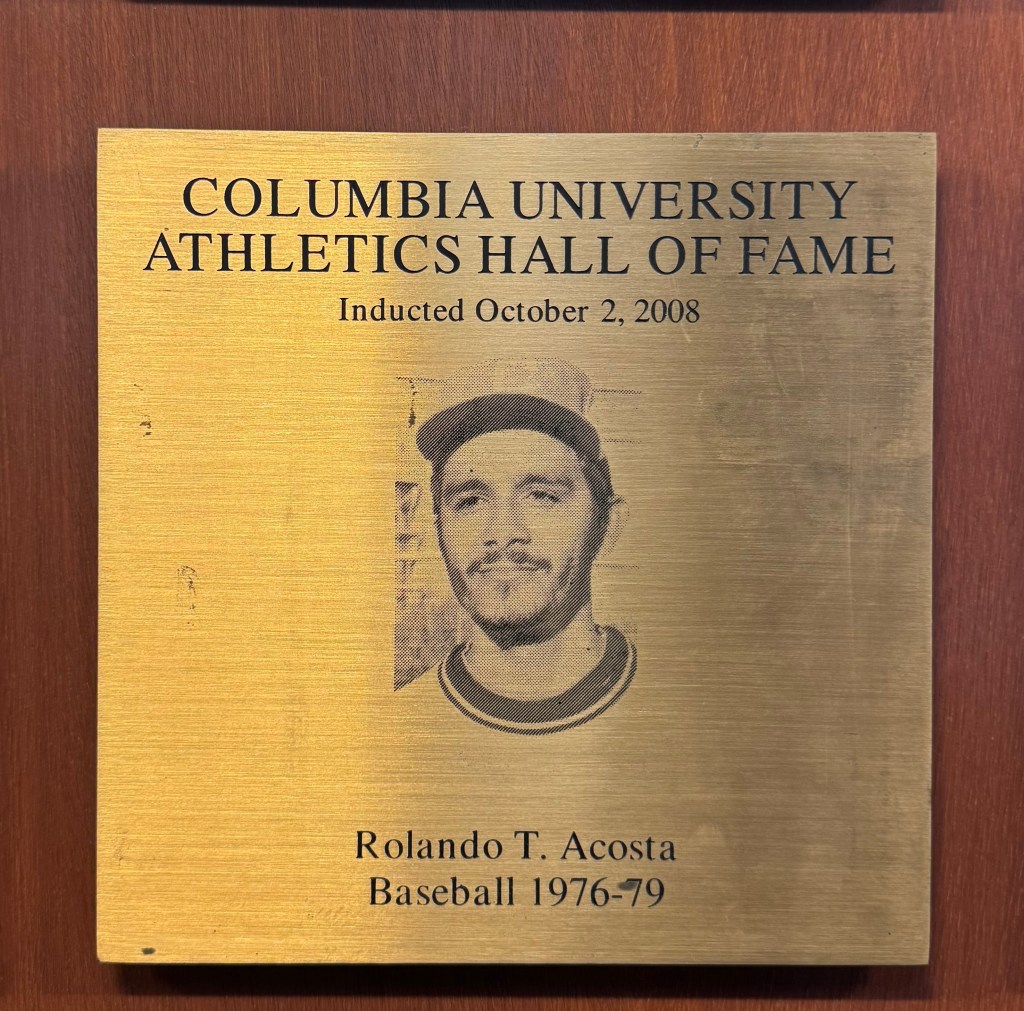
“Lou Gehrig, to any baseball fan, is like a god,” said Rolando Acosta, a Columbia baseball Hall of Famer and former trustee, who now does legal work for the University at a major firm. “He put Columbia baseball and Columbia generally on the map. To honor him with a plaque in an area where he hit quite often, I think it’s a wonderful thing. It sort of comports with our tradition of honoring our own.”
Muldoon requested $5,000 to from SABR to fund a brass plaque and installation. Begley says that the $10,000 grant is typically split among roughly six recipients, making the realistic award closer to $1,650. She advised Muldoon to apply a third time when the window reopens in November 2026, and to seek smaller nominal donations from many organizations (such as the ALS Association and Lou Gehrig’s Columbia fraternity “Live Like Lou”) to demonstrate broad financial backing, and to push SABR National for greater transparency in the grant process.
According to Muldoon, the newest proposal included a letter of support from Columbia Journalism School Dean Jelani Cobb, Dean of Academic Affairs Duy Linh Tu, and backing from Columbia trustee Keith Goggin.
“Keith Goggin shot Jelani and me an email and said, ‘Hey, this thing’s going down. Do you support it?’ — and we were immediately yes,” said Tu. “Without skipping a beat, we were like, yes.”
Tu followed up with an official letter of support to university leadership on behalf of both deans, noting that even Dean Cobb’s loyalty to the team runs through the halls.
“If you’ve ever seen Dean Cobb, he always rocks a Yankees cap,” Tu said.
With the addition of a new sports writing class in the fall and the first sports video newsroom class for students interested in broadcasting and reporting, the Journalism school is actively expanding its sports coverage. Dean Tu sees the Gehrig commemoration as a bridge-building moment between the journalism school and Columbia’s athletics world.
“We’re committed to it. Jelani and I are committed to it. We’re going to make it happen,” said Tu. “I think the plaque signals that publicly that, you know, sports, specifically New York Yankees, local sports are really important to us.”
If approved, Muldoon hopes the plaque could be unveiled when students return in fall 2026.
Muldoon and Goggin have floated the idea of pairing the dedication ceremony with a home-run contest that would recreate South Field’s dimensions and test whether anyone on campus today could match Gehrig’s distance.
Another possible timeline is 2027, which would coincide with the 100th anniversary of the 1927 Yankees, the legendary team often considered one of baseball’s greatest and one that helped cement Gehrig’s place in baseball history.
For Muldoon, the plaque would honor more than one home run. On campus, Lou Gehrig is in the Columbia Athletics Hall of Fame and the prominent Alumni section in Dodge Fitness Center, and there’s a photo of him renovated in the Columbia Baseball locker room at Baker Athletics Complex.
“Lou Gehrig became an iconic figure beyond sports,” Muldoon said. “He gave that farewell speech at Yankee Stadium while he was dying, called himself the luckiest man, and now his name is permanently tied to ALS.”
That connection between Gehrig’s name and ALS continues at Columbia today. Last year, Cole Fellows of the Columbia Lions baseball was named captain of the 2025 Lou Gehrig Community Impact Team, an honor presented by Phi Delta Theta and Live Like Lou Foundation, recognizing college baseball players who reflect Gehrig’s leadership, character, and commitment to service.
For now, the marker remains unbuilt. But the effort continues to place baseball history back onto the steps where Columbia students pass every day.
Questions? Comments? Reach out to victorianewsometv@outlook.com
 CJS Press Box
Leave a comment