
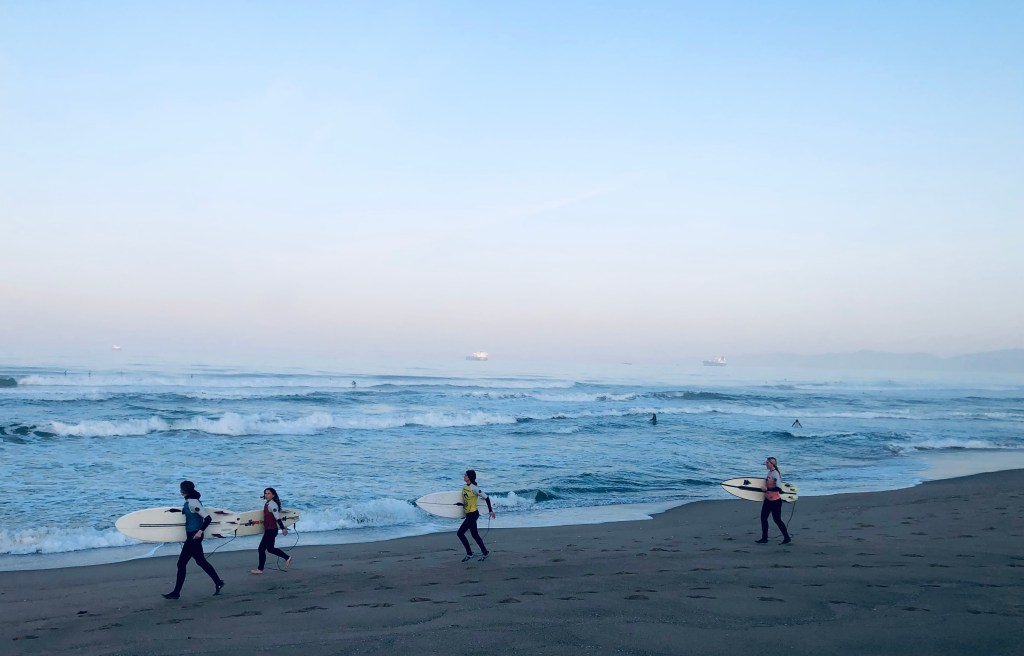
On March 14, if the Pacific Ocean looked clean and the waves were firing, Ryan Harris was going to surf. He grabbed his board and went to his usual spot at the north end of Manhattan Beach, El Porto, a popular surfing location in Los Angeles.
“I’ve been surfing this stretch of sand for 25 years,” he said, his voice rising in clear agitation, retelling the story on his lunch break a few days later. “I literally found a dead dolphin where I surf.”
A daily surfer and maker of eco-friendly boards, Harris is well regarded for his surf reports—size of waves, wind direction and speed, tide—on social media, helping his peers know where and when to paddle out.
Since the Palisades and Eaton fires started on January 7, the Los Angeles County Department of Public Health issued an “ocean water closure and advisory due to fire related impacts” along a nearly-nine mile stretch of the Pacific Coast Highway that includes popular surfing spots, like Topanga Beach. Rain-related closures and advisories followed. But beaches north and south of this area were open.
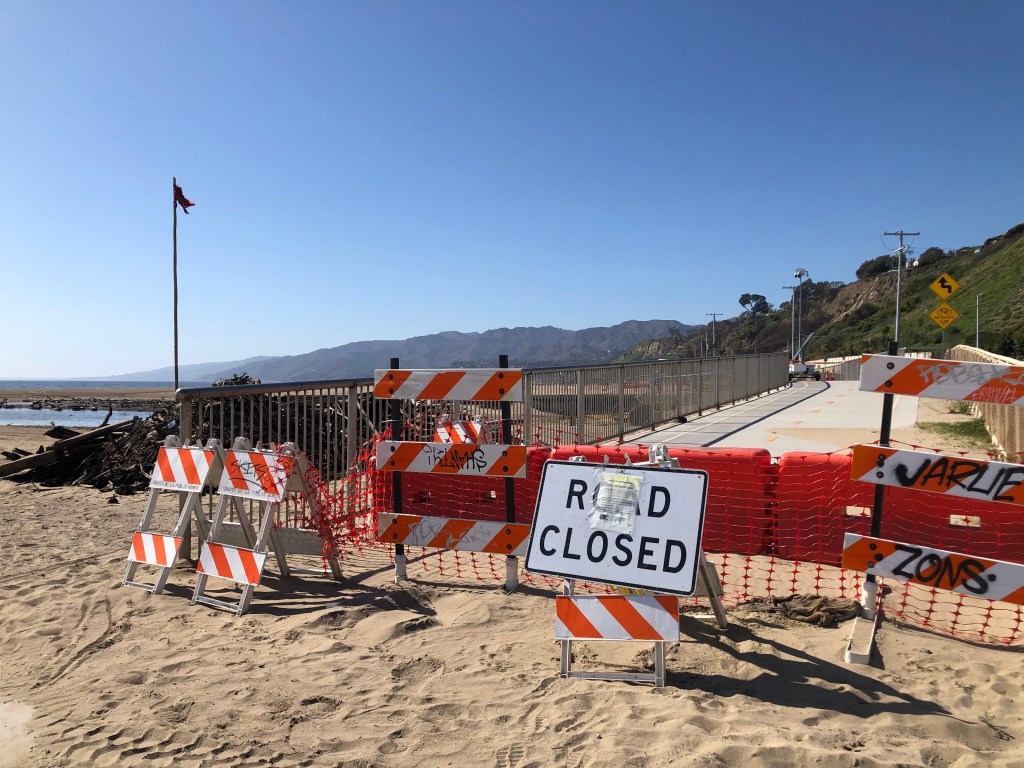
Now dangerously ill and dead sea animals are coming ashore and surfers have reported getting sick. But no available data shows a link. Lack of up-to-date information—and no clean-up—has surfers frustrated. They’re forced to choose between pursuing their passion and protecting their health.
“Surfers, we’re idiots,” Harris says with a mix of humor and sincerity. “We see good waves and we go in.”
After the fires, huge and small remnants of charred homes and other detritus in the air, sand, and water sparked Harris to include water quality in his regular reports.
“As a surfer, sometimes I try to justify warning signals so I get my enjoyment,” says Manhattan Beach resident David Curry. “Those were just chunks that floated 10 miles, not chemicals in the water from the wildfire,” he adds wryly, mimicking his inner voice. Initial fire debris was dangerously large on top of questionably toxic.
With no clear information, until high winds at the end of February carried wildfire ash into the South Bay—the southern end of Santa Monica Bay’s 55 miles of coastline—only rain deterred surfers from going in.
When there’s enough rainfall that inland run-off—everything that collects on streets, lawns, and ground surfaces—drains into the ocean, the L.A. County Department of Public Health issues a “Ocean Water Quality Rain Advisory” at impacted beaches. This “72-hour rule”, as locals call it, suggests people avoid swimming, surfing, and playing in ocean waters, for three days.
You may have seen “no dumping; drains to ocean” signs over grates. That’s real.
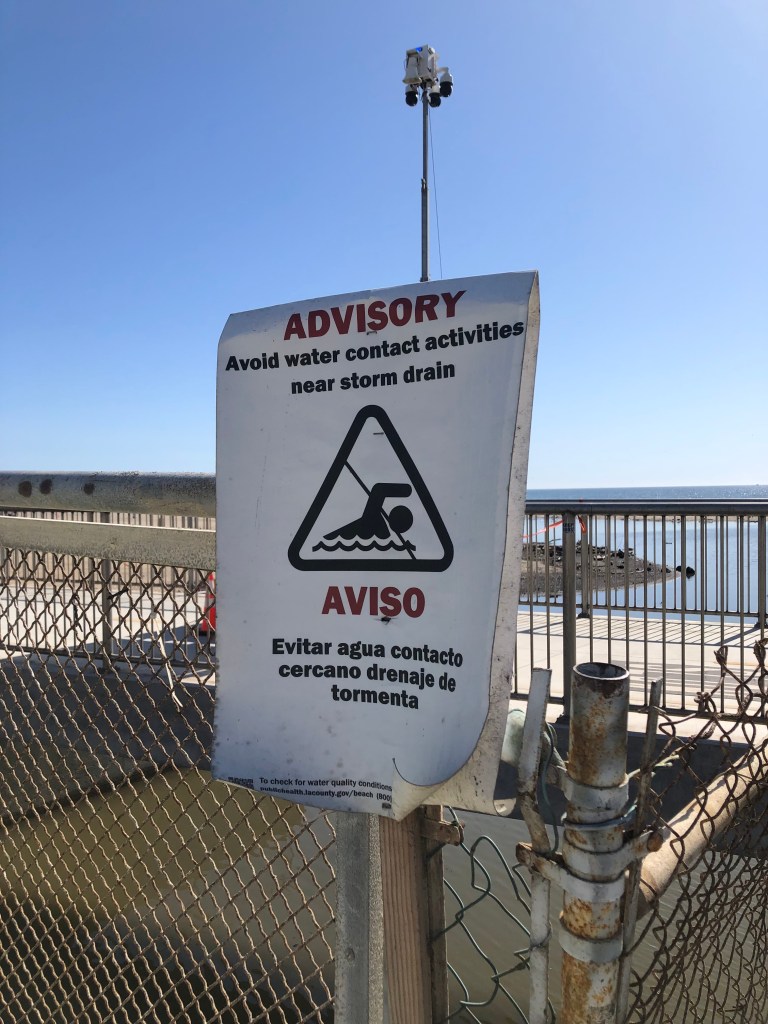
Run-off can have motor oil, cigarette butts, pesticides, trash, plastics, particulate matter from air pollution (tiny pollutants like mercury and lead in the air), dust, and sewage (including viruses and pathogens from human and animal waste) that can create risks to aquatic life and human health.
Surfers say they’ve built immunity from so much time in the ocean. But lately they’ve been talking, during the lulls between waves, of toxins, headaches, and sinus infections.
On March 11, El Segundo resident Ethan Rogers went in because the water “wasn’t super dark” (not murky brown). He described the feeling that followed: no bueno, icky, not like a cold but sinuses stuffed.
According to the L.A. County Department of Beaches and Harbors, the 18 beaches they control are not hazardous to the public. They monitor the water with other agencies, including the Regional Water Quality Control Board and the County Departments of Public Health and Public Works. The State Water Resources Control Board is involved too.
“More outreach is needed to better explain how health agencies are making their determinations on the safety of the water or the beach,” says Mara Dias, water quality initiative senior manager for the Surfrider Foundation, a nonprofit environmental organization dedicated to protecting oceans and beaches.
She says the raw data reports released so far are “very difficult and likely nearly impossible for the general public to decipher: More transparency and clarity in the test results and the decision-making process is still necessary.”
You’ll struggle to find anyone who spends as much time as surfers do paying attention to their home ocean. Before they get on their boards, before they enter the water, they observe.
Now they’re seeing a toxic algal bloom. And they wonder: Is it connected to the fires; is it safe?
Algae are microscopic organisms. Some produce toxins, stimulated by light, temperature, and levels of salt, acidity (pH), and nutrients, including chemicals (in fertilizer, for example) that enter the ocean from stormwater runoff.
When toxin-producing algae grow excessively it becomes a toxic algal bloom Fish and shellfish that consume it, pass the toxin on when eaten up the food chain.
In the air the toxins can lead to respiratory disease.
According to the National Institute of Environmental Health Sciences, people are not immune. Eating fish (this toxin is not killed by cooking heat), swimming, drinking the water, and breathing the air are other ways to be exposed.
In 2020, per a CDC report of 13 states, 227 harmful algal blooms led to 95 cases of human illness, and at least 1,170 cases of animal illness.
If you have ever seen a poisoned California sea lion writhing in pain on sand still dotted with tiny and less tiny chunks of wildfire debris, surrounded by orange cones to give him space from tourists and dogs until a Marine Mammal Care Center rescuer arrives, you know the severity.
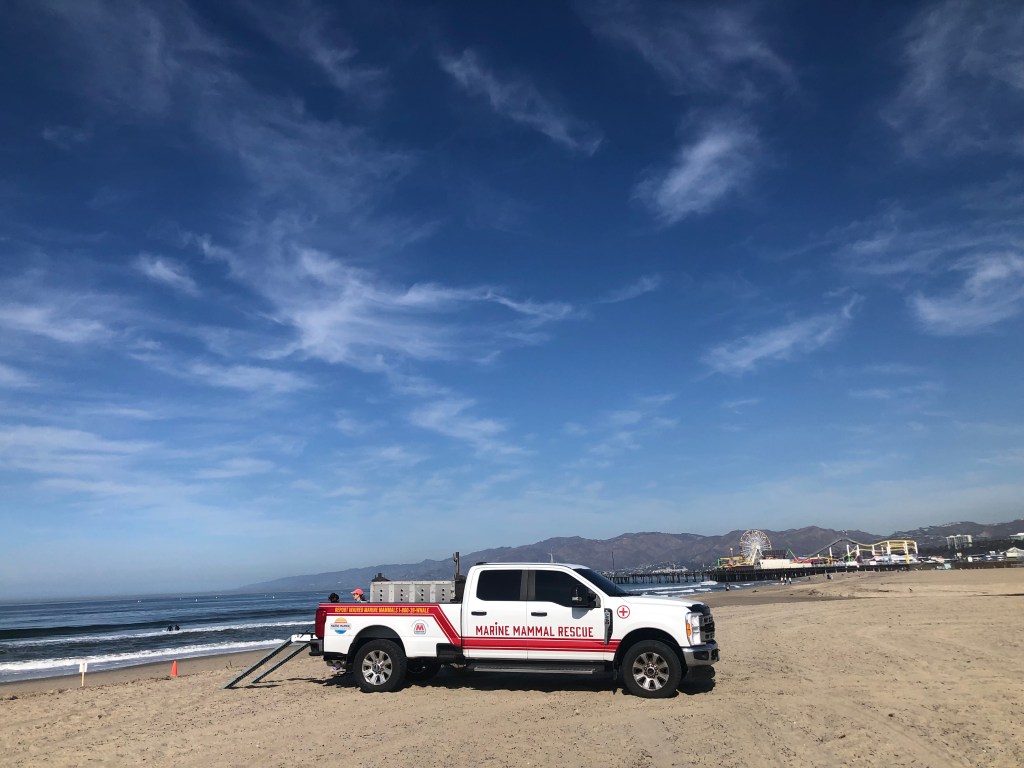
One sea lion is near Santa Monica Beach Lifeguard Tower 20, about half a mile south of the famous pier.
“He’s sick,” volunteer Randi Parent, says to a man pausing to look. She explains the sick animals get antibiotics, the care facility is overcapacity, and offers a double-sided Domoic acid flyer describing the neurotoxin and how to help (call (800) 399-4253 for rescue assistance if you see a stranded animal).
Parent says there are not enough signs on the beach explaining water quality.
According to NOAA, the current harmful algae outbreak began around mid-February near Malibu. It spread north and south and has affected hundreds of sea animals, so far. It’s the fourth consecutive year the area has an outbreak.
This one began much earlier (early summer is typical), likely due to a surge of upwelling—water from the deep ocean is pushed up to fill in for surface water pushed aside by wind; deep water is loaded with nutrients—around the time it started.
“There have been some studies suggesting that fire debris can introduce more nutrients in the coastal ocean, but we don’t know that about this case so far,” said NOAA Public Affairs Officer Michael Milstein.
Coincidentally, NOAA had a research ship off Southern California at the time of the L.A. fires. They’re analyzing water, ash, and fish samples they took to determine whether debris or runoff from the fires contributed to the algal bloom.
In the meantime, surfers are left to their own best judgment.
For Harris, everything changed that March morning. “Do you think I’ll go in the water when I see a dead, freaking not even in distress, dead, right where I stretch, dolphin?” he said. “You can’t ignore that sign.”
He posted his reaction to Instagram, hoping it will be a call-to-action for everyone.
“The most frustrating part is when you’re in a time of crisis you count on your local government agencies and elected officials to do the right thing,” says Harris. “They’re just issuing the 72-hour rule. I know it’s unprecedented and they’ve never had a study on humans, but come on!”
Harris and his peers want to know what’s going on and they want the beach to be cleaned up.
“It’s unfortunate that communities that suffer through horrific events like the L.A. fires are left with uncertainty about where it’s safe to enter the water or even sit on the beach,” says Eugenia Ermecora, Surfrider L.A. Chapter Manager.
Last week, Heal the Bay released a report of 116 pollutants, tested via a third party, using samples from 10 locations in January and February.
Online they offer hope and mixed messages: These data sets do not tell us the current conditions in the Santa Monica Bay but they do provide insight; water quality at L.A.’s beaches was much better than expected; testing results revealed troubling findings for marine life.
“We have to rely on a lot of data uncertainty,” said Jeffrey Schlegelmilch, Director of the National Center for Disaster Preparedness at the Columbia Climate School, earlier in the month after visiting the fire sites.
He noted contamination thresholds deemed acceptable for human health can be measured to “extraordinary precision” but that does not make them practical. If something is dangerous at 10 parts per million, he says as an example of potency, and it’s detected at 10.5 or 9.5, is it safe?
Schlegelmilch said personal risk determinations have wide variance. Are you otherwise healthy? Are you planning for yourself or a family? Will learning more fuel anxiety?
In contrast, he says, public health officials often use binaries: Yes or no. In or out.
Studies show the COVID pandemic highlighted how this type of communication, denying people the opportunity to potentially protect themselves because they weren’t trusted with information (like, it’s safer to stay home but homemade masks do limit exposure) is unhelpful.
“Most people are going to do what they’re going to do anyway,” says Schlegelmilch. The challenge for public health officials is to learn what those behaviors are and guide people towards the healthiest ones.
I told him about some strategies surfers employ: limiting surf session time; showering immediately after getting out of the ocean; rinsing ears and noses with saline or vinegar or both. He said it demonstrates people want to protect themselves.
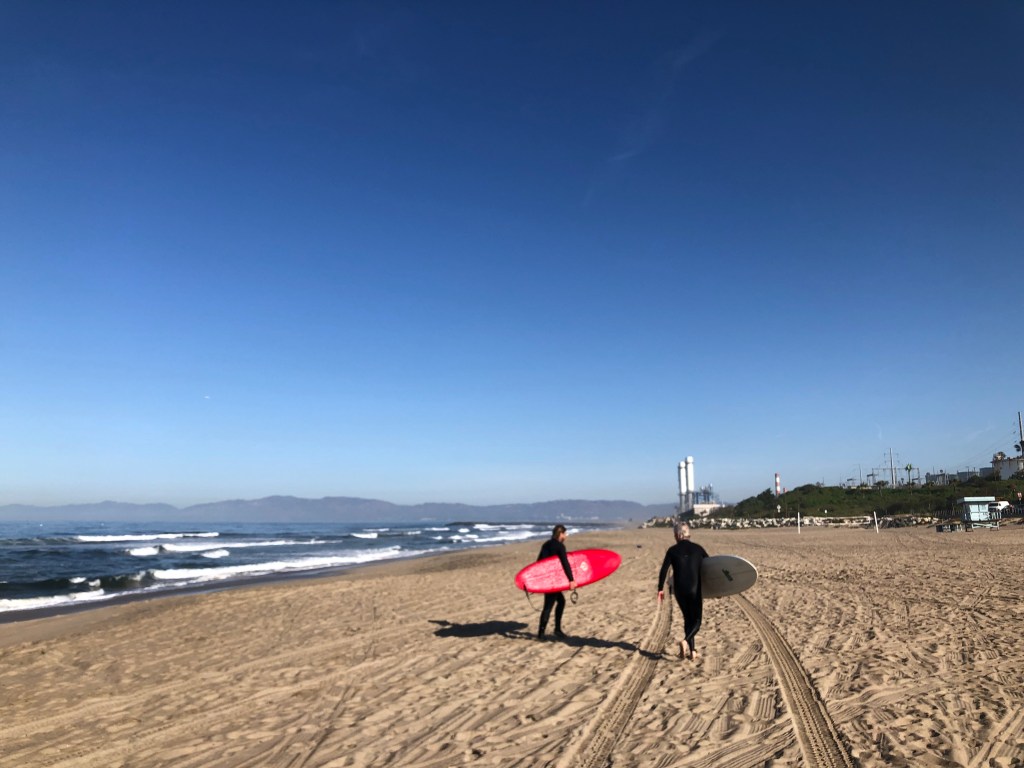
In El Porto on that spring day, asked what surfing provides, Anya Thein and Mia Berger, still in their wetsuits, took turns creating an impromptu list: peace; relaxation; no screens; nothing else exists.
It’s Berger’s first day in since the fires. Past contaminant exposure left the Redondo Beach resident with ear infections and acne. But it was time. “I just needed to go in,” she said—glowing and content in that way only exercise inspires.
“Time stops,” says Thein, who grew up in Topanga Canyon, no stranger to fire evacuations, raising her face to the sun, eyes closed to take it in.
Berger laughs in appreciation. She’s seen this meditative look many times.
They’re smart, educated on environmental issues, and interested in sustainability. But no invisible, undeclared, health hazard could outweigh this bliss.
“If someone has a deep spiritual connection with the sea, if it’s important to their identity, they’re not going to not go out there,” says Schlegelmilch.
Besides clean beaches, surfers want information they can trust. Communication.
And, as Harris says, “Nobody wants to see dead dolphins.”
—Reported March 2025—
 CJS Press Box
Leave a comment