
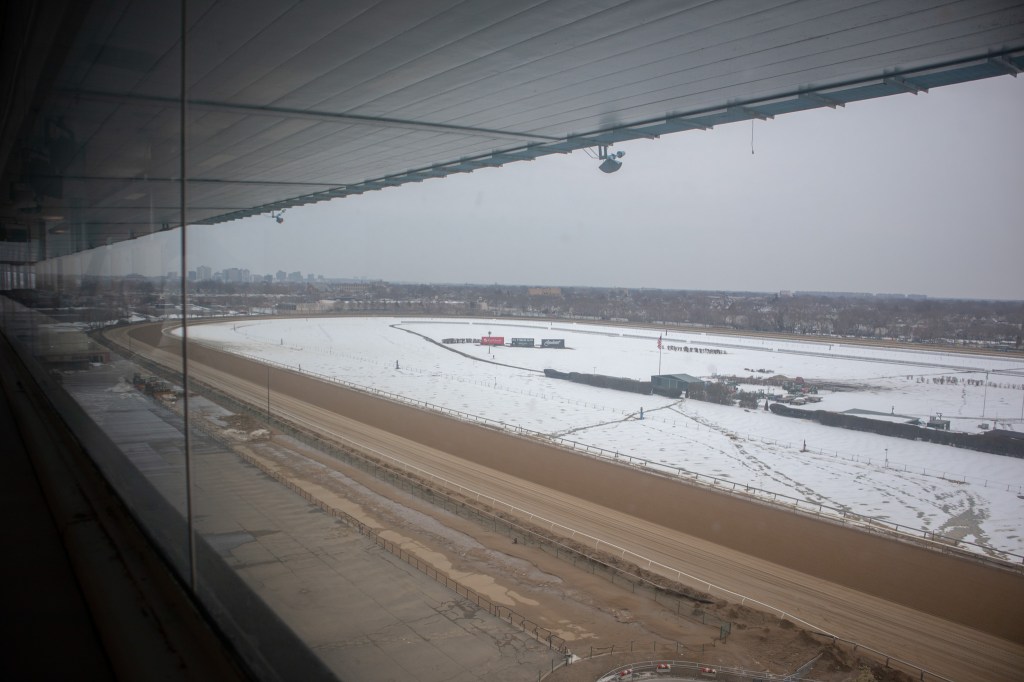
The sound of horse hooves pounding is not many people’s first thought when driving through the area surrounding John F. Kennedy International Airport. Right before the exit to long-term parking, a monolith of hotels attached to a casino seemingly rises out of nowhere. In the center of it all stands Aqueduct Racetrack in Queens, New York.
As commercial jets fly overhead, horses draped in colorful banners can be caught galloping around the 132-year-old oval track. The jockeys, usually short in stature and extremely lightweight, crouch on top of their horses as they attempt to run a mile within a minute. On a recent race day, a light layer of snow lays across the fields surrounding the facility as a brown horse named Doppio Espresso crosses the finish line just in front of hazelnut-colored Holly Ln.
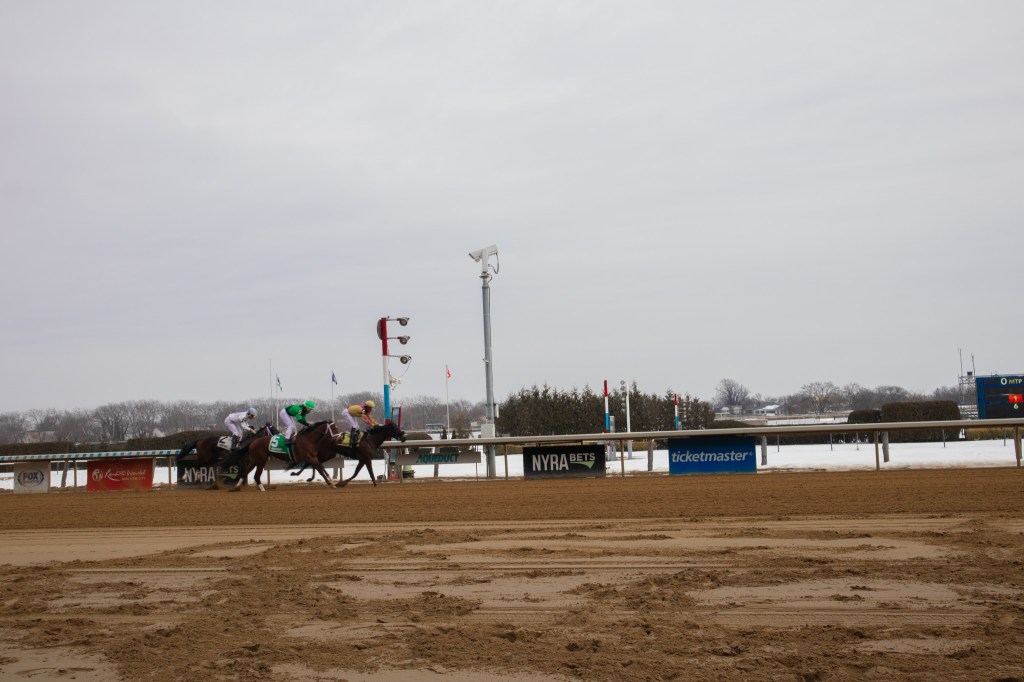
(Left to right) Dolly’s Jolene, Holly Ln and Doppio Espresso cross the finish line at Aqueduct Racetrack, Feb. 15, 2026. © Amalia Wompa
At 1:10 p.m., this was the first race of the day, and bettors were already waiting by the paddock to both heckle and compliment the incoming jockeys who tried to ignore them. Some with crumpled tickets in their hands, others with cash ready to try again. For one man, this scene is all too familiar, and he gets a bird’s-eye view of the whole spectacle from the announcer’s booth.
Chris Griffin, a confident man with a wide smile, has been the Aqueduct’s track announcer for almost three years. His booth, which looks out onto the track, is covered in notes, colored pens and a homemade contraption constructed out of a clipboard, wire and duct tape, designed to wrap around his neck.
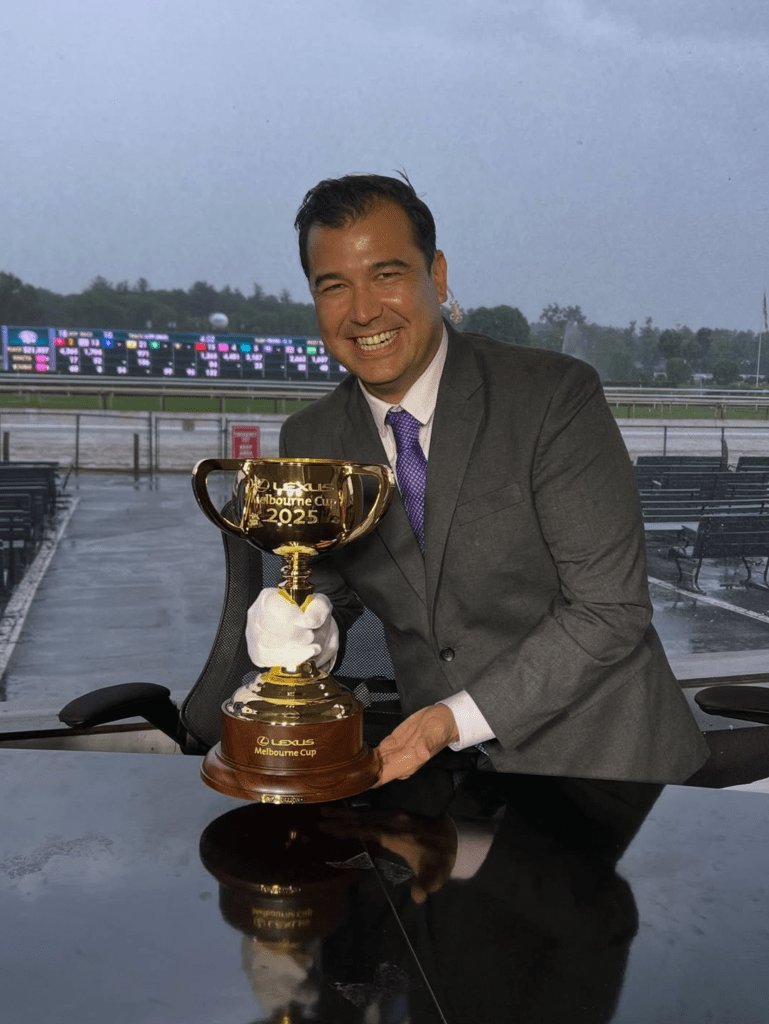
Chris Griffin holds the Melbourne Cup trophy at Saratoga Race Course in Saratoga Springs, N.Y. Photo courtesy of Griffin’s Instagram account, @inthegrandstand.
“I use this as a cheat sheet. It allows me to peek down if I need to see something,” Griffin said. The clipboard contains key facts about the day’s races for easy reference.
Before announcing for the New York Racing Association, Griffin worked for the California Authority of Racing Fairs and even the Harlem Globetrotters, totaling 15 years of sports announcing experience. Originally from Los Angeles, Griffin was announcing for a Globetrotters tour in Arkansas when horse racing announcer Frank Mirahmadi heard his voice boom throughout the show. At a later show in California, Griffin approached Mirahmadi’s booth and asked what it would take for him to call a race. Impressed, Mirahmadi offered him a job.
“One thing led to another and here I am 10 years later in New York,” Griffin said. “I’ve always loved horse racing. It’s a unique audience, and it’s more narration than play-by-play.”
To an outsider, horse racing announcing can sound similar to the cadence of an auctioneer. Griffin barely takes a breath between action as he confidently lists the horses’ names and their movements on the track.
Griffin’s shifts are usually six hours long, and on Feb. 15, he prepared for his first race by refreshing himself on if there are any changes to the jockey or horse rosters, while rehearsing names out loud. Doppio Espresso and Holly Ln were some of the tamer names of the circuit, making the first race a good warmup. Other times, Griffin is thrown a curveball.
“We just had a race not too long ago that was Sassy Princess, Baby Sassicaia, and something else with a Sassa…” he said, “All three horses had this double S. It was a tongue twister, and you feel pretty good when you don’t get tied up.” Later research revealed that the third horse’s name was Sassafrassness.
During races, which are 20 minutes apart and last a little over a minute each, Griffin explained the technique behind announcing for a horse race. He explained that although the foundation of the races have the same structure every time, the horses and jockeys are always different.
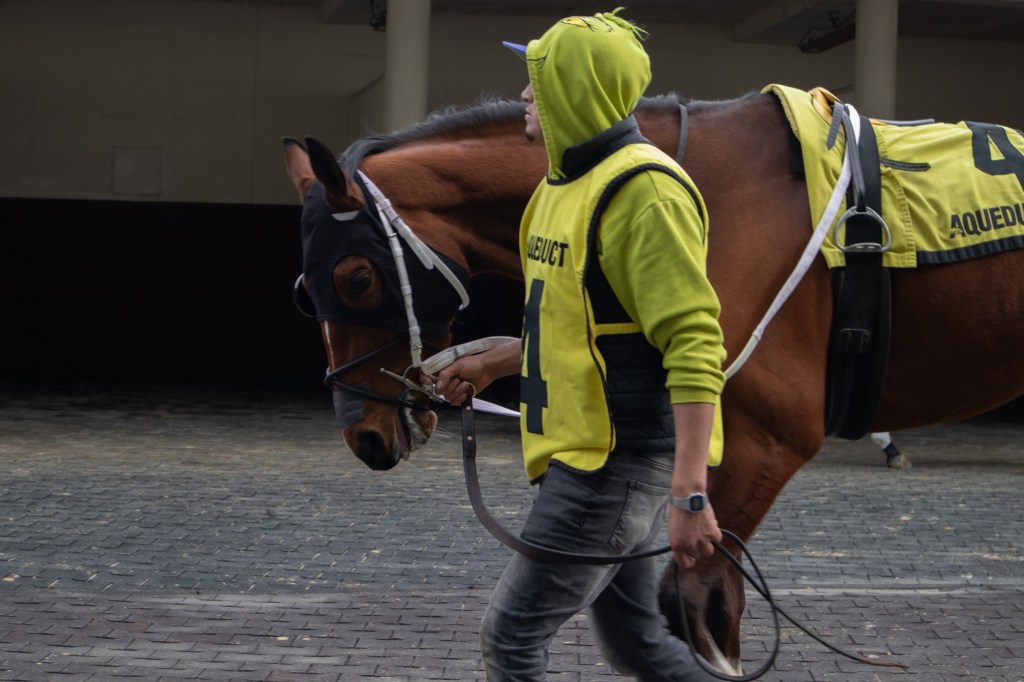
Doppio Espresso is walked around the paddock after a race at Aqueduct Racetrack, Feb. 15, 2026. © Amalia Wompa
“I used to be a very internal thinker. You have to speak it out loud. If I say these names to myself in my head, I’m not gonna memorize it,” Griffin said.
When it comes to entertainment value, Griffin tries to keep the same level of excitement regardless of the stakes at hand. The lowest level race is referred to as a Maiden Claiming race, whereas the highest would be considered a Grade 1 race. Even though they feature different levels of experience, purses and different attendance rates, behind every horse is still a bet, with the outcome mattering intensely to those who wagered it.
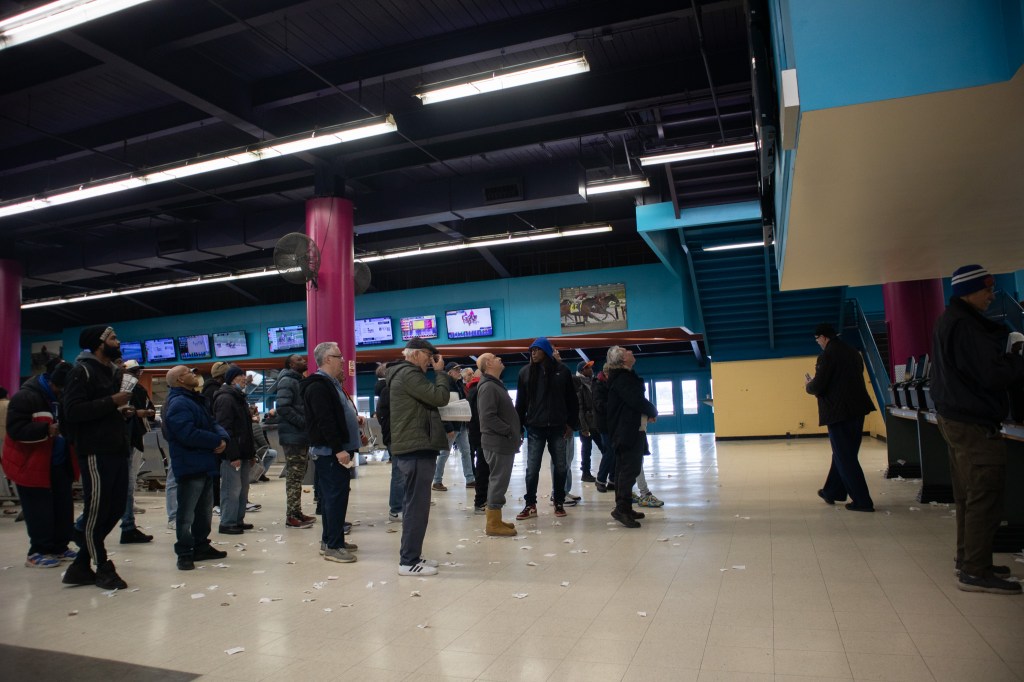
Bettors crowd the screen on top of crumpled tickets from the last race’s losers at Aqueduct Racetrack, Feb. 15, 2026. © Amalia Wompa
“There’s a lot of different things that can happen during a race that you have to be prepared for and adapt to. Because not one race is exactly the same. It’s always going to be something different and you need different ways to explain the action and make it sound better for the crowd,” Griffin said.
Although Griffin said he’s not usually recognized by his voice, he mentioned that avid followers of the sport, especially those watching on TV who don’t have the distraction of a raucous crowd behind them, have his voice in their ear more prominently, which raises the pressure for him to speak seamlessly.
“I used to think about that a lot, but not so much anymore,” said Griffin, “I just have to talk and let it happen.”
 CJS Press Box
Leave a comment